

The 100 envelope challenge is exactly what it sounds like: you number 100 envelopes from 1 to 100, pick one each day (or at your own pace), and stuff in the matching dollar amount. Finish all 100 and you’ll have saved the sum of every integer from 1 to 100, calculated as 100 × 101 ÷ 2. That’s a real, tangible savings goal you can hit without a budget overhaul or a financial planner.
- Total saved (classic version): a fixed sum over 100 days
- Daily commitment: amounts increasing from the smallest to the largest envelope number
- Flexibility: you can halve amounts, slow the pace, or shrink the number of envelopes — the structure stays the same
The beauty of this cash envelope challenge is that the math is already done for you. Pick an envelope, put in the cash, repeat. The only real question is which version fits your budget.
Table of Contents
- What is the 100 envelope challenge, exactly?
- How to do the 100 envelope challenge, step by step
- How much will you actually save, and what are the variants?
- Pros and cons: is this challenge right for you?
- What should you do with the money after you finish?
- How to stay consistent and fix common problems
- Supplies, trackers, and Mariaandherjournal bundles that make it easier
- Key Takeaways
- Why the 100 envelope challenge is more than a savings gimmick
- Mariaandherjournal makes the challenge worth looking forward to
- Useful sources and further reading
What is the 100 envelope challenge, exactly?
At its core, the challenge uses 100 envelopes numbered 1 through 100. Each time you participate — daily, weekly, or whenever you choose — you pull one envelope at random and deposit the dollar amount written on it. Envelope #47 means $47 goes in. Envelope #3 means $3. No complicated rules, no spreadsheet required on day one.
You’ll hear it called several things:
- 100-day envelope challenge — (same concept, emphasizing the physical envelope)
- Cash stuffing challenge (when tied to the cash-stuffing budgeting method)
Physical envelopes give you a tactile, visual experience — you can see the stack grow, feel the weight of progress. Digital versions, where you mark a virtual envelope and transfer the equivalent to a savings account, trade that sensory satisfaction for security and the chance to earn interest while the challenge runs. Many people land somewhere in the middle: physical envelopes for the ritual, a savings account transfer for the actual money.

How to do the 100 envelope challenge, step by step
What you need before you start
Physical supplies are minimal: 100 envelopes, a marker, and a storage container (a shoebox works fine). Add a printable tracker or a binder if you want a visual record of your progress.
The setup and daily routine
- Number your envelopes. Write the numbers 1 through 100 on the front of each envelope, one number per envelope. Use a bold marker so the numbers are easy to read at a glance.
- Shuffle and store them face-down. Put all 100 envelopes in your container in random order. This randomizes which amount you contribute each day, which keeps the challenge from feeling predictable.
- Pick one envelope per session. Pull one envelope without looking at the number. This is the amount you’ll stuff today.
- Add the matching cash. Withdraw or set aside the dollar amount on the envelope, place it inside, seal it, and put it back in a separate “done” pile or section of your binder.
- Mark your tracker. Cross off or color in that number on your printable grid or digital tracker. Watching the grid fill up is genuinely motivating.
- Repeat until all 100 are filled.
Tracking options
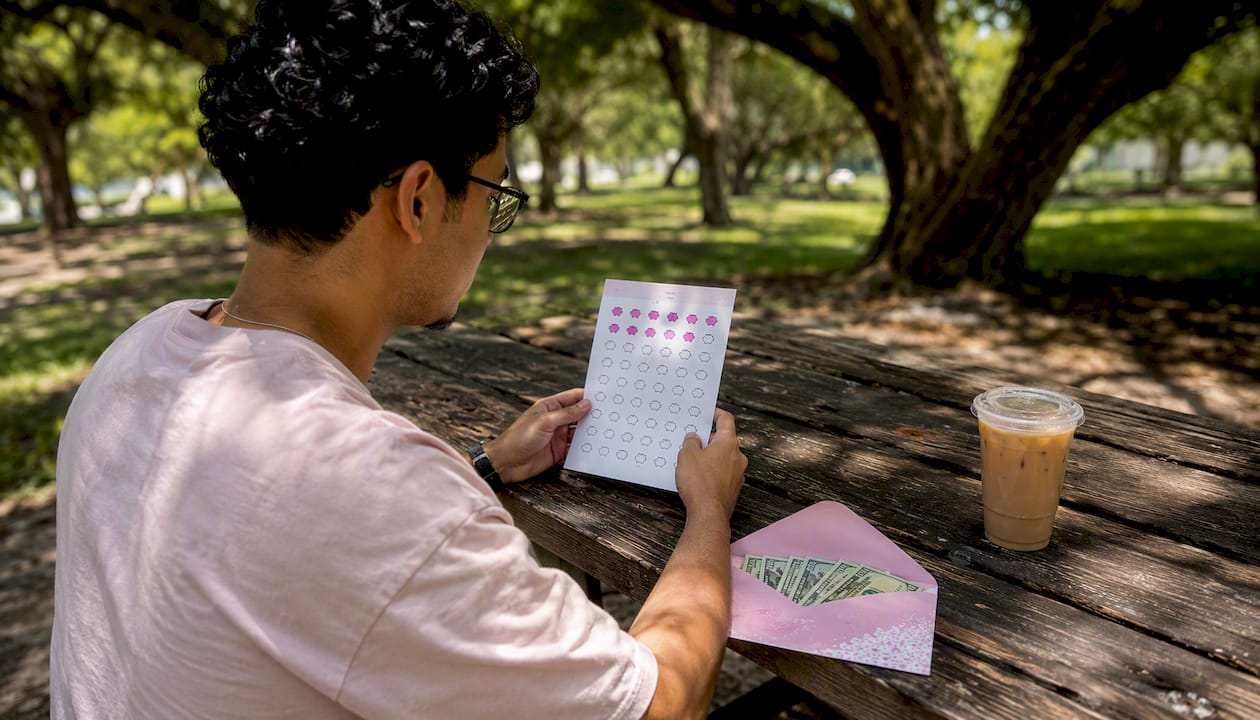
- Printable grid tracker: a 10×10 grid numbered 1–100; cross off each number as you go. Simple, visual, and satisfying. Pair it with a savings challenge printable for a ready-made version.
- Budget binder: keeps envelopes, your tracker, and any notes in one place. Good for people who already use a cash-stuffing system.
- Spreadsheet: Google Sheets or Excel; easy to track running totals and remaining amounts.
- Digital app: banking apps or budgeting apps like YNAB let you log virtual “envelope” contributions and transfer funds directly to savings.
Pro Tip: Batch your ATM withdrawals. Instead of going to the bank every day, pull cash once a week based on the envelopes you expect to fill. And plan ahead for high-number envelopes — if you know #98 and #99 are still in the pile, budget for them before the end of the month.
How much will you actually save, and what are the variants?
The classic version saves a sum calculated by the formula for the sum of consecutive integers from 1 to n, n(n+1)/2. Plug in 100: 100 × 101 ÷ 2. No rounding, no approximation.
Common adaptations include halving every envelope amount or switching to a weekly fill schedule when daily contributions aren’t realistic. Here’s how the numbers shake out across the most popular versions:
| Variant | How it works | Total saved | Completion timeline |
|---|---|---|---|
| Classic (daily) | $1–$100, one envelope per day | $5,050 | ~100 days |
| Half-amount | $1–$50, one per day | $2,525 | ~100 days |
| Weekly pace | $1–$100, one per week | $5,050 | — |
| 50-envelope | $1–$50, one per day | $1,275 | ~50 days |
The weekly pace and 50-envelope options keep the same behavioral structure while lowering the cash burden per period. If you’re working with a tighter budget, the half-amount version is the most direct swap — same 100 envelopes, same timeline, half the pressure. For more ideas on adapting the method to a smaller income, the cash stuffing for low income guide covers practical pacing strategies.
Pros and cons: is this challenge right for you?
What works well
- Gamified motivation. Pulling a random envelope each day turns saving into a small daily event rather than a chore. The unpredictability keeps it interesting.
- Clear, finite goal. You know exactly when you’re done and exactly how much you’ll have. That clarity is rare in personal finance.
- Visual progress. A filling grid or a growing stack of sealed envelopes makes abstract savings concrete. Visual trackers measurably increase completion rates compared with no tracking system at all.
- Habit-building. The daily ritual builds a savings habit that tends to outlast the challenge itself.
- Shared goal potential. Couples or roommates can run the challenge together, splitting envelopes or alternating days.
Where it gets difficult
- Cash security. Keeping $5,050 in physical envelopes at home carries real risk. Theft, fire, or accidental spending can wipe out weeks of effort.
- No interest earned. Cash in an envelope earns nothing. A $5,050 balance sitting in a high-yield savings account would generate meaningful interest over the same period.
- Late-stage strain. The last 10–15 envelopes (numbers 86–100) require $86–$100 each. If those land in the same week, you’re looking at $500–$900 in a single week.
- Not ideal for variable income. Freelancers or anyone with irregular paychecks may find the randomness of high-number envelopes landing at the wrong time genuinely stressful.
The challenge fits best if you respond well to visual systems, have a relatively stable income, and want a short-term savings goal with a clear finish line. If the cash security concern is a dealbreaker, the digital hybrid approach — tracking on paper, transferring to a savings account — solves it without losing the structure.
What should you do with the money after you finish?
Finishing the challenge is the easy part. Keeping the money working for you is where most people lose ground. Here are the most practical options:
- Emergency fund top-up. If you don’t have three to six months of expenses saved, this is the highest-priority use. The U.S. Department of Labor recommends building an emergency fund before focusing on other financial goals.
- Targeted debt payoff. Apply the lump sum to your highest-interest debt first (the avalanche method) or your smallest balance (the snowball method). Either approach beats letting the cash sit idle.
- Sinking fund. Earmark the money for a specific upcoming expense — a car repair fund, a vacation, holiday gifts. A dedicated sinking fund prevents you from raiding other savings categories.
- High-yield savings account (HYSA) or short-term CD. If you don’t have an immediate use for the money, move it somewhere it earns interest. An HYSA at an online bank typically offers significantly better rates than a traditional savings account.
Pro Tip: Don’t wait until the challenge ends to move cash to a safer place. As your envelope pile grows past $1,000, transfer completed amounts to an HYSA in batches. You’ll earn interest during the challenge and reduce the risk of keeping large cash at home.
Splitting the money across two goals — say, half to an emergency fund and half to a debt payment — is a legitimate strategy. The key is deciding before you finish, not after, so the money doesn’t quietly disappear into everyday spending.
How to stay consistent and fix common problems
Tips for staying on track
- Start with high-value envelopes. Pull numbers 100, 99, and 98 first, on purpose. Tackling the hardest envelopes early when motivation is highest means the later weeks get progressively easier, not harder.
- Batch-fill on strong weeks. Had a good week financially? Fill two or three envelopes instead of one. You’ll build a cushion for leaner weeks.
- Use a visible tracker. Keep your grid somewhere you’ll see it daily — on the fridge, inside your planner, or as your phone wallpaper. Out of sight really does mean out of mind.
- Set a calendar reminder. A simple daily phone alert at the same time each day removes the “I forgot” excuse entirely.
- Break it into quarters. Cumulative milestone totals make the goal feel smaller: Q1 gets you to $325, Q2 to $1,275, Q3 to $2,850, and Q4 to the full $5,050. Celebrate each bracket.
Troubleshooting common problems
Missed a day (or a week)? Catch up by filling multiple envelopes in one session rather than abandoning the challenge. Missing days is normal — quitting is the only real failure.
Low-cash week and a high-number envelope came up? Set it aside and pull a lower-number envelope instead. Come back to the high-number one when your budget allows. The challenge doesn’t require strict chronological order.
Lost or damaged an envelope? Replace it with a new one, write the same number on it, and mark it as caught up on your tracker. The money is what matters, not the physical paper.
Running out of cash between paydays? Switch to the digital hybrid method temporarily — log the contribution on your tracker and transfer the amount to your savings account instead of stuffing physical cash.
Pro Tip: Find an accountability partner. Share your milestone totals with a friend, a partner, or an online community. People who track progress publicly finish savings challenges at higher rates than those who go it alone. A small reward at the 25-, 50-, and 75-envelope marks (a coffee, a movie night) keeps the momentum real.
Supplies, trackers, and Mariaandherjournal bundles that make it easier
What you need to start
- 100 envelopes (standard letter size works; decorative ones make the process more enjoyable)
- A bold marker for numbering
- A storage box, accordion folder, or budget binder to hold envelopes
- A printable 1–100 grid tracker or a binder with tracking pages
- Optional: a pen for journaling notes, washi tape for sealing, or decorative stickers for milestone markers
Using a printable tracker
A 10×10 grid numbered 1–100 is the simplest tracker format. Print one, tape it to the inside cover of your binder, and color in each number as you complete it. Watching the grid fill from mostly blank to nearly full is a surprisingly powerful motivator. Pair it with a progress binder that holds your sealed envelopes in order, and you have a complete physical record of the challenge from start to finish.
Mariaandherjournal’s cash-stuffing challenge bundles are built specifically for this kind of challenge. Each bundle includes handmade envelopes, coordinated tracking pages, and decorative accessories — including the brand’s signature beaded paperclip bookmarks, which work beautifully as progress markers in a binder. The handmade quality means every piece is made with care, not mass-produced, and the soft, aesthetic design makes the daily ritual genuinely pleasant rather than purely functional. Everything you need to run the challenge with style is in one place.
Browse the full range of cash-stuffing supplies on the Mariaandherjournal site, or check the savings challenge collection for bundles designed around popular savings formats including this one.
Key Takeaways
The 100 envelope challenge saves exactly $5,050 by filling envelopes numbered 1–100 with matching dollar amounts, and it works best when paired with a visual tracker and a clear plan for the money at the end.
| Point | Details |
|---|---|
| Total saved (classic) | Fill all 100 envelopes and you save $5,050 — the sum of integers 1 through 100. |
| Flexible by design | Half-amount ($2,525), 50-envelope ($1,275), and weekly-pace versions fit tighter budgets. |
| Visual tracking matters | A printable grid or binder tracker measurably increases the likelihood of finishing. |
| Plan for the money first | Decide before you finish whether the funds go to an emergency fund, debt, or an HYSA. |
| Mariaandherjournal bundles | Handmade cash-stuffing bundles and beaded paperclip bookmarks from Mariaandherjournal make the daily routine easier and more enjoyable. |
Why the 100 envelope challenge is more than a savings gimmick
Most personal finance advice tells you to automate everything — set up a recurring transfer and forget about it. That works for long-term investing. It does almost nothing for the psychological side of saving, which is where most people actually struggle.
The envelope method forces a daily decision. You pick the envelope, you find the cash, you seal it. That friction is the point. It builds the muscle memory of treating savings as non-negotiable, not as whatever’s left over at the end of the month. The gamified structure — random draws, visible grids, milestone brackets — isn’t a distraction from “real” budgeting. It’s a behavioral tool that makes the habit stick in a way that a bank transfer never will.
The one thing most guides get wrong: they treat the challenge as a standalone event. The $5,050 matters, but the habit you build over those 100 days matters more. Use the challenge as a launchpad. Once you’ve proven to yourself that you can set aside money consistently, the next step is putting that same discipline into a system that compounds — an HYSA, a Roth IRA contribution, a debt payoff plan. The envelope challenge is the training ground, not the finish line.
Mariaandherjournal makes the challenge worth looking forward to
Physical budgeting tools only work if you actually want to use them. Mariaandherjournal’s handmade cash-stuffing bundles solve the “I’ll start tomorrow” problem by making the daily envelope ritual genuinely something to look forward to.
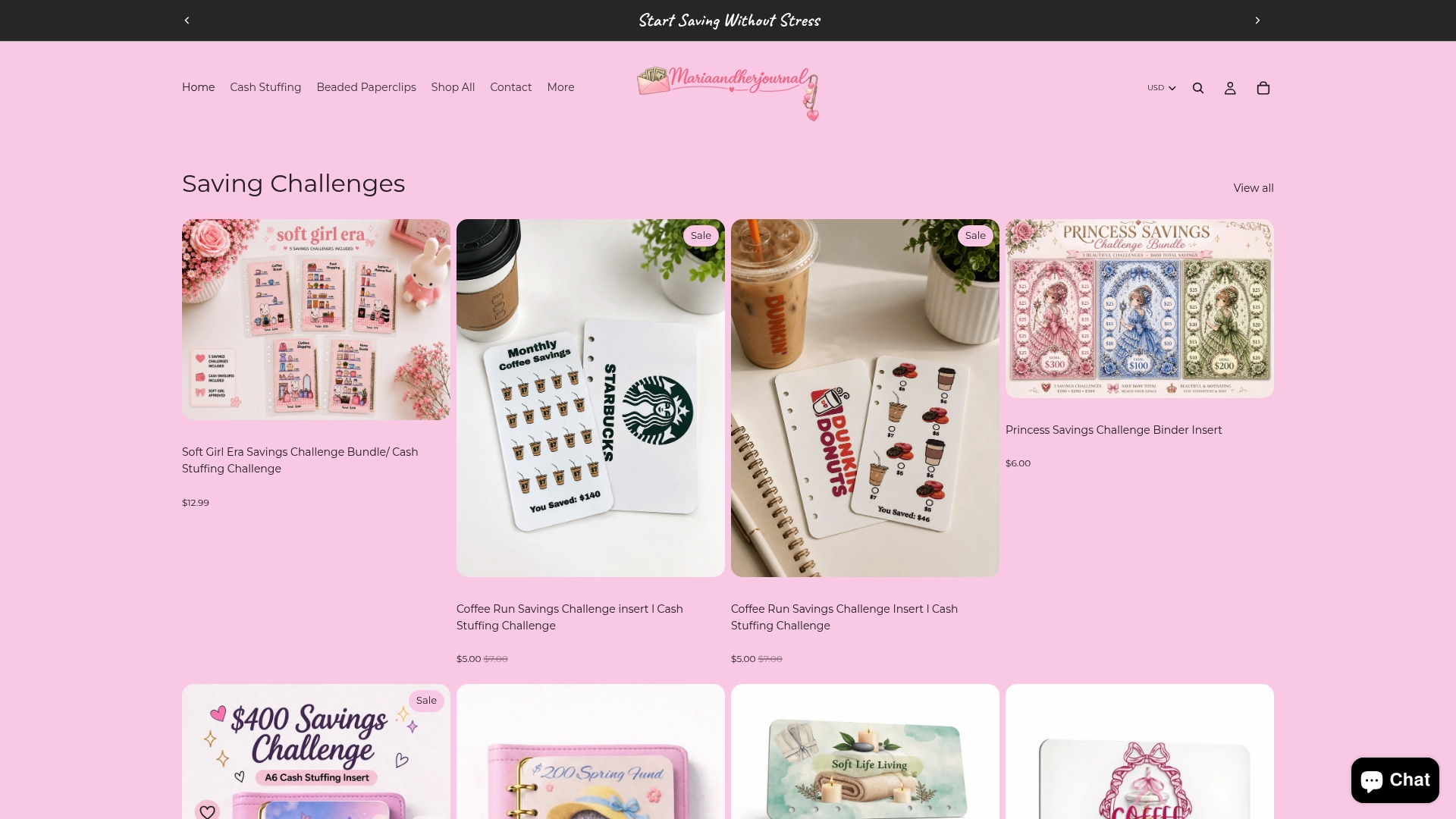
Each bundle includes coordinated envelopes, tracking pages, and accessories designed around the savings challenge format. The beaded paperclip bookmarks double as progress markers in your binder — a small detail that makes a real difference when you’re 60 envelopes in and need a visual reminder of how far you’ve come. The bundles work equally well for first-timers running the classic $5,050 version and for anyone adapting the challenge to a smaller budget.
Browse the savings challenge bundles and find the one that fits your goal — or pick up individual cash-stuffing essentials if you already have some supplies and just need to fill the gaps.
Useful sources and further reading
- What Is the 100 Envelope Challenge and How Do You Do It? — Fidelity: clear breakdown of variants and the catch-up approach for missed days.
- The 100 Envelope Challenge: How It Works — SuperMoney: side-by-side numbers for the half-amount, 50-envelope, and weekly-pace variants.
- Savings Fitness — U.S. Department of Labor: government guidance on emergency funds and savings priorities — useful for deciding what to do with the money after the challenge.