

The 26 week savings challenge is a half-year savings plan where you make one deposit per week (or every other week) for 26 weeks, building a real cash cushion without overhauling your budget. The most popular incremental version starts at $3 in week one and adds $3 each week, reaching $1,053 by week 26. A $5 start on the same schedule lands you at $1,755. If you have a fixed goal in mind, like $5,000, you simply divide by 26 to get a flat weekly deposit of about $192.
This plan works for beginners and low-income savers because the early deposits are small enough to feel manageable, and a printable tracker makes every week’s progress visible. Grab a printable savings tracker before you read further, and you can start filling it in today.
Quick-start totals at a glance:
- $3 incremental start: $1,053 total (week 1 deposit: $3, week 26 deposit: $78)
- $5 incremental start: $1,755 total (week 1 deposit: $5, week 26 deposit: $130)
- Fixed $5,000 goal: ~$192 per week for 26 weeks
- Fixed $1,000 goal: ~$38 per week for 26 weeks
- Biweekly pay cycle: same totals, deposits every other week instead of weekly
Key Takeaways
A $3 incremental start saves $1,053 in 26 weeks; a fixed $5,000 goal requires roughly $192 per week, and a separate savings account keeps the money safe and visible throughout the challenge.
| Point | Details |
|---|---|
| Core totals | $3 start = $1,053; $5 start = $1,755; fixed $5,000 goal = ~$192/week for 26 weeks. |
| Best storage for most people | A separate savings account or high-yield savings account, FDIC-insured up to $250,000. |
| Easiest low-income adaptation | Start at $1 or $2 per week (totals: $351 or $702) or use a flat small fixed amount like $20/week. |
| Stick-with-it system | Automate the transfer and manually mark a printed tracker each week to keep the habit loop active. |
| Mariaandherjournal | Handmade savings challenge bundles with pre-filled tracker inserts, cash-stuffing envelopes, and beaded paperclip bookmarks. |
Table of Contents
- How does the 26 week savings challenge math work?
- What should you look for in a printable 26-week tracker?
- How can you adapt the challenge for a tight budget or biweekly paycheck?
- Where should you keep the money during the challenge?
- How do you actually stick with the challenge for 26 weeks?
- Ready-to-print 26-week schedules for three common goals
- How Mariaandherjournal’s handmade trackers help you finish the challenge
- Why printable trackers work better than you’d expect
- Handcrafted tracker bundles from Mariaandherjournal
- Sources
How does the 26 week savings challenge math work?
The 26-week plan is essentially a compressed version of the classic 52-week challenge. The 52-week challenge saves $1,378 over a full year by depositing $1 in week one, $2 in week two, and so on through $52. The 26-week version doubles those weekly amounts and completes the same arc in half the time.
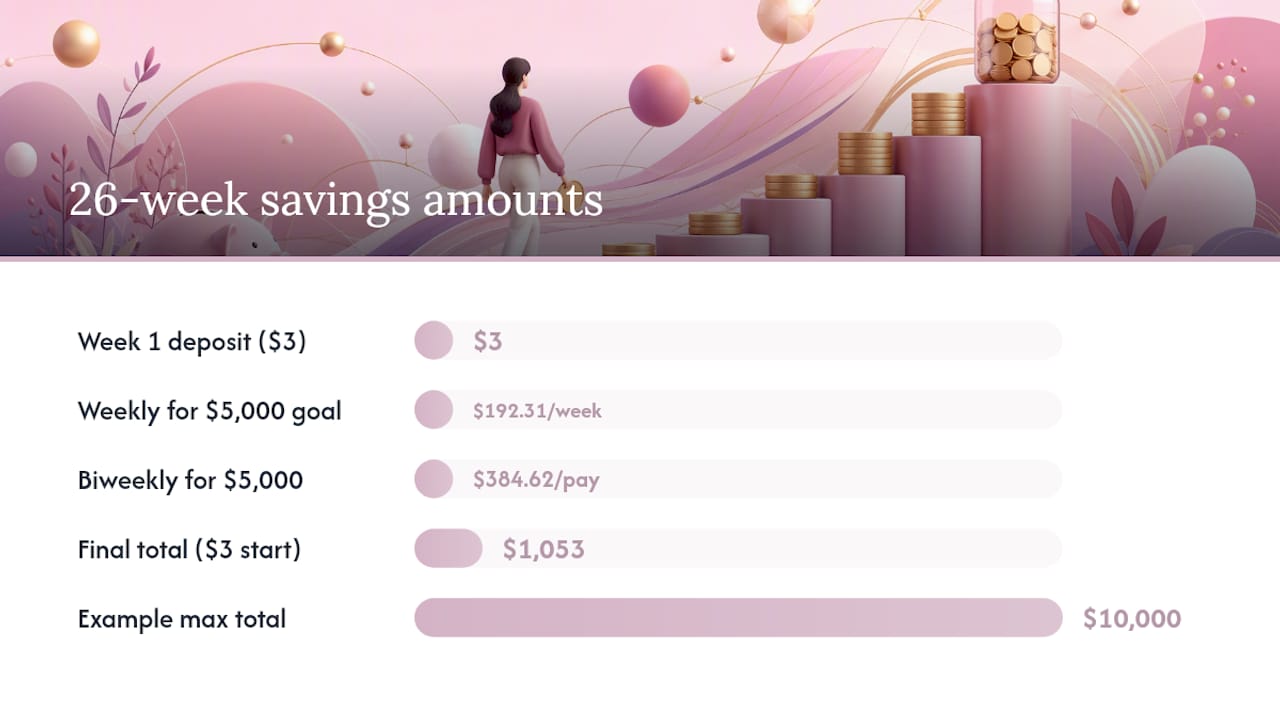
The incremental formula is straightforward. Your deposit in any given week equals your starting amount multiplied by the week number. Total savings equal the sum of all deposits, which follows the triangular-number formula: (weeks × (weeks + 1) ÷ 2) × starting increment. For a $3 start: (26 × 27 ÷ 2) × $3 = 351 × $3 = $1,053.
Worked example 1: $3 incremental start
Worked example 2: Fixed $5,000 goal
Divide your target by the number of deposits. For 26 weekly deposits: $5,000 ÷ 26 = $192.31 per week. For 13 biweekly deposits (if you align to a biweekly paycheck): $5,000 ÷ 13 = $384.62 per paycheck. SoFi’s biweekly challenge guide shows how flexible deposit amounts can push totals anywhere from roughly $1,000 to $10,000 depending on what you choose.
Three steps to set up your own schedule:
- Pick your method: incremental (small start, growing deposits) or fixed-goal (same amount every week).
- Choose your starting amount or target total and run the formula above.
- Write every deposit amount into a printable tracker before week one so there are no surprises mid-challenge.
What should you look for in a printable 26-week tracker?
A good tracker does two things: it tells you exactly what to deposit each week, and it gives you something satisfying to mark off. Printable 26-week templates are widely available for $1,000 and $5,000 goals, and the best ones come in multiple formats so they fit your actual planner or binder.
Common printable formats and their trade-offs:
- Single-sheet schedule (US Letter or A5): Fits most printers, easy to tape inside a planner. Best for people who want one glanceable reference.
- Color-in tracker: Each week’s box gets shaded when the deposit is made. Highly motivating because progress is literally visible on the page.
- Binder card set: Individual cards for each week, punched for a ring binder. Works well with cash-stuffing envelopes because you can tuck the card with the cash.
- CSV file: Useful if you want to set up automated bank transfers or track in a spreadsheet. Multiple template sizes and a CSV option increase usability across planners, binders, and automated transfers.
Features worth checking before you print:
- Weekly deposit amounts pre-filled (not blank)
- Running cumulative total column so you always know where you stand
- A reverse-order option (largest deposit first) for people who prefer to tackle the hardest weeks early
- Notes column for logging where the money came from
- Print settings that fit standard home printers without cutting off edges
Physical tools add a tactile layer that screens can’t replicate. Cash-stuffing envelopes let you physically separate each week’s savings from spending money. Binder cards keep the whole schedule in one bound place. A savings challenges book or decorated binder makes the habit feel intentional rather than obligatory.
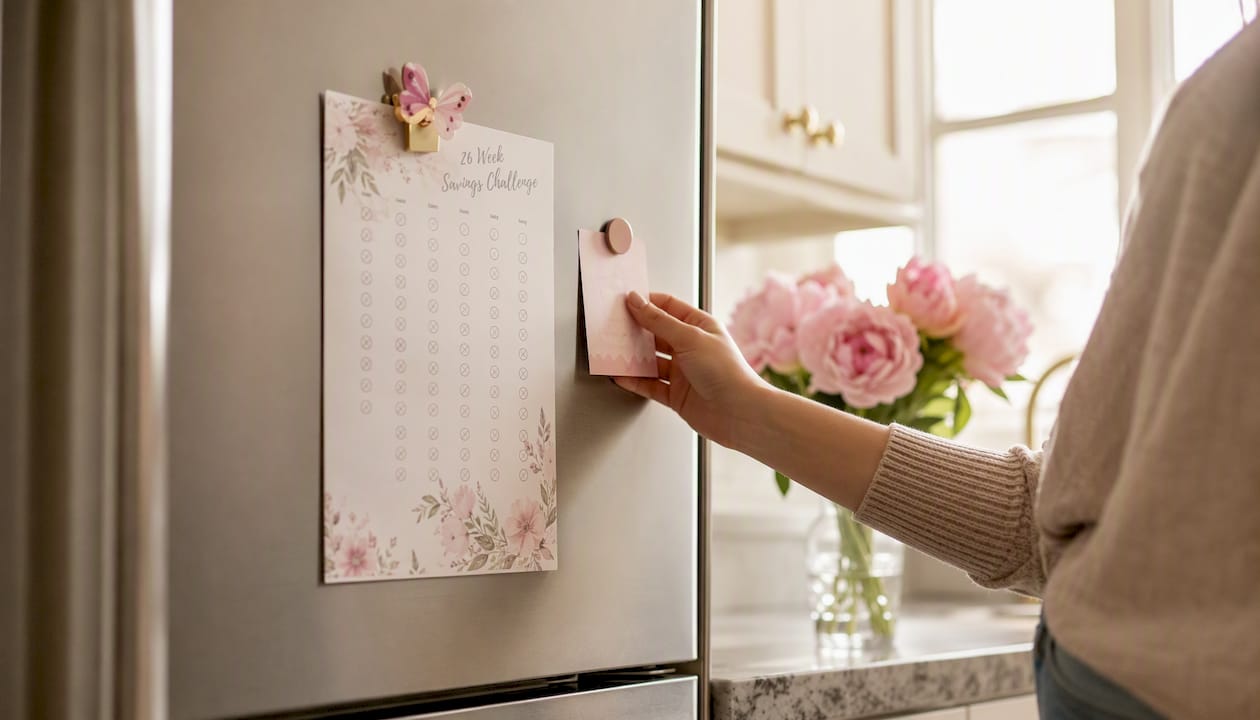
Pro Tip: Print multiple copies of your tracker: one for your binder and another posted somewhere visible daily, like the refrigerator. The extra copy serves as a passive reminder without additional cost.
How can you adapt the challenge for a tight budget or biweekly paycheck?
The standard incremental schedule assumes weekly deposits that grow over time, which can feel steep by week 20. The good news is that the structure bends without breaking. Savings challenges for low-income savers cover several of these adaptations in detail.
Reverse order: Start with week 26’s largest deposit and work backward to the smallest. This front-loads the hardest amounts when motivation is highest and leaves easy deposits for the final weeks, which often coincide with holiday spending. It’s the same total, just a different sequence.
Biweekly paycheck alignment: If you’re paid every other week, you make 26 deposits over 52 weeks, or 13 deposits over 26 weeks. Map each deposit to payday so the money moves before it can be spent elsewhere.
Low-income-friendly variants:
- $1 incremental start: Total of $351 over 26 weeks. Small enough to start on almost any budget.
- $2 incremental start: Total of $702. A solid emergency fund starter.
- Fixed small amount: Pick a flat number you know you can hit every week, like $10 or $20, and stick to it. $20 × 26 = $520, which covers most small emergencies.
- Split-week deposits: If one weekly amount feels large, split it into two smaller transfers mid-week.
- Cash-back and side-gig top-ups: Round up cash-back rewards or a single extra gig shift to cover a week’s deposit when cash is thin.
Practical ways to free up deposit money include reviewing streaming subscriptions, packing lunch a few days a week, and switching to store-brand staples. These small swaps can free up enough for mid-challenge deposits without requiring a dramatic lifestyle change.
Pro Tip: If you miss a week, don’t quit. Split the missed deposit across the next two weeks instead of trying to catch up in one lump sum. Consistency over perfection is what gets you to week 26.
Where should you keep the money during the challenge?
The safest, lowest-friction option for most people is a separate savings account dedicated solely to the challenge. Keeping it apart from your checking account removes the temptation to dip in, and the separation makes your progress easy to see at a glance.
Three solid options:
- Dedicated savings account: Open a second account at your existing bank and label it “26-week challenge.” Free to open at most institutions, FDIC-insured up to $250,000 per depositor.
- High-yield savings account (HYSA): Same FDIC protection, but your balance earns interest while you save. Worth considering if your total will sit for several months.
- Cash envelope system: Physical cash in labeled envelopes, stored somewhere secure at home. No interest, but the tactile visibility helps some savers stay motivated. The risk is theft or loss, so a locked box is worth it.
The FDIC insurance note matters: any savings account at an FDIC-member bank protects your deposits up to $250,000, so your challenge funds are safe even if the bank fails. Cash at home carries no such protection.
Automation tip: Set a recurring transfer on payday for the exact deposit amount. For incremental schedules, update the transfer amount each week or set a calendar reminder to do it manually. The hybrid approach works best: automate the transfer so the money moves without willpower, then manually mark your printable tracker to keep the habit loop alive.
How do you actually stick with the challenge for 26 weeks?
Automation handles the money movement. Your tracker handles the motivation. The combination is what gets most people to the finish line, according to behavioral guidance on multiweek savings challenges.
Tactics that work:
- Set a recurring calendar alert on the same day each week labeled “savings deposit + mark tracker.”
- Tell one person your goal. An accountability partner doesn’t need to participate, just to ask you about it occasionally.
- Color in or check off your tracker the moment the transfer clears, not later.
- Keep your tracker somewhere visible, not buried in a drawer.
Milestone rewards at logical checkpoints:
- Week 6: You’ve saved roughly $63 on a $3-start plan. Treat yourself to something small and free, like a favorite playlist or a long walk.
- Week 13 (halfway): You’re at $273 on the $3-start plan. A slightly bigger reward fits here, like a home-cooked special dinner.
- Week 26: You’ve hit $1,053. This is worth a real celebration, proportional to what you saved.
Pro Tip: Automate a flat baseline transfer (say, $20/week) and then manually top it up to the week’s actual amount. That way, even if you forget to adjust, something always moves. The manual top-up keeps you engaged without making the whole system fragile.
For more money-saving challenge tips that stick, the habit loop is the core mechanism: a weekly cue (calendar alert), a routine (transfer + mark tracker), and a small reward (visible progress). Repeat 26 times.
Ready-to-print 26-week schedules for three common goals
Three starter templates cover the most common goals. Print the one that fits your budget, or use all three as references when building a custom schedule.
Template 1: $3 incremental start (total: $1,053)
Template 2: $5 incremental start (total: $1,755)
Template 3: Fixed $5,000 goal (flat weekly deposit)
Using these templates:
- Print: Download as a PDF sized for US Letter (8.5 × 11 in.) or A5 for a planner insert.
- CSV: Copy the deposit column into a spreadsheet and use it to schedule recurring bank transfers with varying amounts.
- Reverse order: Flip the deposit column so week 1 has the largest amount. Same total, front-loaded difficulty.
- Biweekly version: Use 13 rows instead of 26, doubling each deposit. The $3-start biweekly version deposits $6 in period one and $156 in period 13, for the same $1,053 total.
You can also customize a savings challenge on Canva to match your planner’s color scheme and add your own goal labels before printing.
How Mariaandherjournal’s handmade trackers help you finish the challenge
A printed schedule tells you what to save. A handcrafted tracker makes you want to save. The physical act of marking off a beautifully designed card each week creates a small but real sense of accomplishment that a phone notification simply doesn’t replicate. Physical savings challenge bundles are a recognized product category precisely because tactile tools improve follow-through.
Mariaandherjournal’s handmade tracker bundles are built around this idea. Each kit includes:
- Cash-stuffing envelopes: Pre-labeled for each week’s deposit, so the money is physically separated the moment it’s set aside.
- Printable tracker inserts: Pre-filled with weekly amounts for common starting increments, ready to slide into a binder or planner.
- Beaded paperclip bookmarks: Mark your current week in a binder or planner so you never lose your place in the schedule.
Browse the full savings challenge collection to find the bundle that matches your goal and planner style.
Why printable trackers work better than you’d expect
Most people assume motivation is the problem when they abandon a savings challenge. In practice, the problem is usually friction: the deposit amount wasn’t written down, the week was forgotten, or there was no visible record of progress to look back on.
A physical tracker removes all three friction points at once. The amounts are pre-filled, the weekly ritual is built into the object itself, and the marked-off weeks are permanently visible. That’s not a minor convenience. Customers who pair a handmade binder with an automated bank transfer consistently report finishing challenges they’d previously abandoned mid-way. The tracker doesn’t replace discipline; it makes discipline easier to sustain.
The one thing I’d push back on in the broader savings-challenge conversation is the idea that digital apps are just as effective. They can be, but they require you to open them. A binder sitting on your desk requires nothing. It’s already there, already asking to be marked.
Handcrafted tracker bundles from Mariaandherjournal
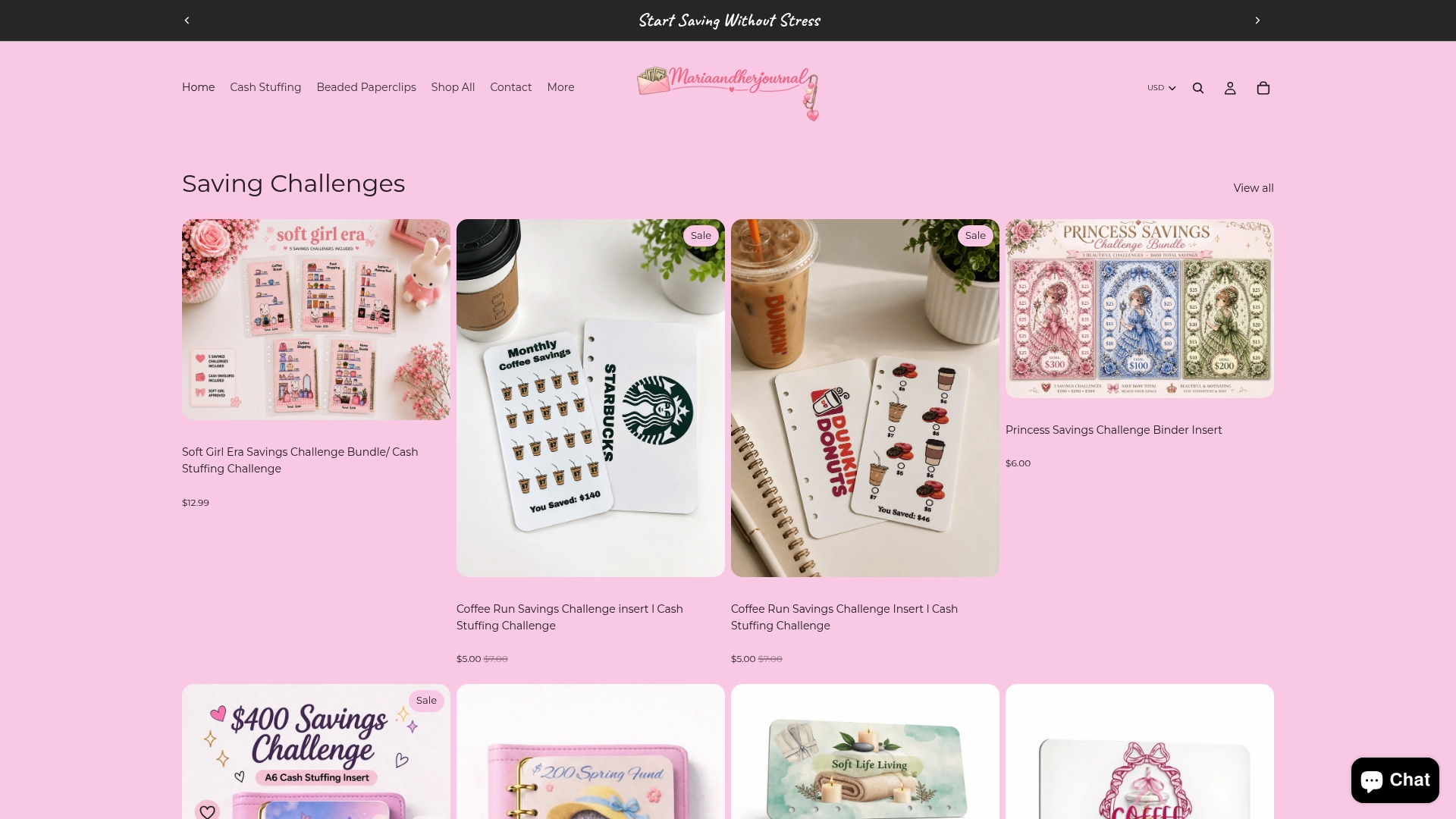
Mariaandherjournal’s savings challenge bundles are handmade specifically for beginners and low-income savers who want a tactile, organized system rather than another app. Each bundle pairs pre-filled tracker inserts with cash-stuffing envelopes and a beaded paperclip bookmark, so your binder is ready to use the day it arrives. Set up a recurring bank transfer for your baseline weekly amount, then use the envelope and tracker to manage any manual top-ups. The result is a hybrid system: automated consistency plus the weekly ritual that keeps you engaged. These are paid products from Maria and Her Journal. Browse the collection and pick the bundle that matches your 26-week goal.
Sources
- 52 Week Savings Challenge (2026 Edition) | SoFi
- 26-Week Savings Challenge
- 26 Week Money Challenge Printable – Save $5000 or $1000! - Life and a Budget
- 26-Week Money Challenge + Free Printable Savings Trackers - Sane Spending
This article is general information, not a substitute for advice from a qualified financial advisor. Consult a qualified financial professional about your own circumstances before acting on anything here.