

Buy a handmade A6 binder with refillable inserts, a set of cash-stuffing envelopes, and a savings-challenge bundle with beaded paperclip bookmarks. Those three items cover everything a physical budgeting system needs.
- A6 binder with inserts: holds all your envelopes in one place, protects them from wear, and keeps your tracker sheets right where you need them
- Cash-stuffing envelopes: give each spending category its own physical boundary so overspending becomes immediately visible
- Savings-challenge bundle + beaded paperclip bookmarks: turn a savings goal into a trackable, visual game and mark your active pages at a glance
Mariaandherjournal makes all three by hand, and their A6 vs A7 sizing guide is the clearest starting point if you are not sure which binder fits your bag.
Pro Tip: Start with the binder size, then buy envelopes and inserts to match. Buying envelopes first and discovering they don’t fit your binder is the most common beginner mistake.
Table of Contents
- What do the best journal accessories actually do in a cash-stuffing system?
- How do you choose the right size, material, and features?
- Which starter kit should you buy first?
- How do you run a cash-stuffing system week to week?
- How do you keep handmade accessories in good shape?
- Where should you buy handmade budgeting accessories in the U.S.?
- Key Takeaways
- Why handmade tools change how budgeting feels
- Handmade budgeting accessories from Mariaandherjournal
- Useful sources and further reading
What do the best journal accessories actually do in a cash-stuffing system?
Each accessory has a specific job. Understanding that job helps you skip the items you don’t need and invest in the ones that will actually change how you budget.
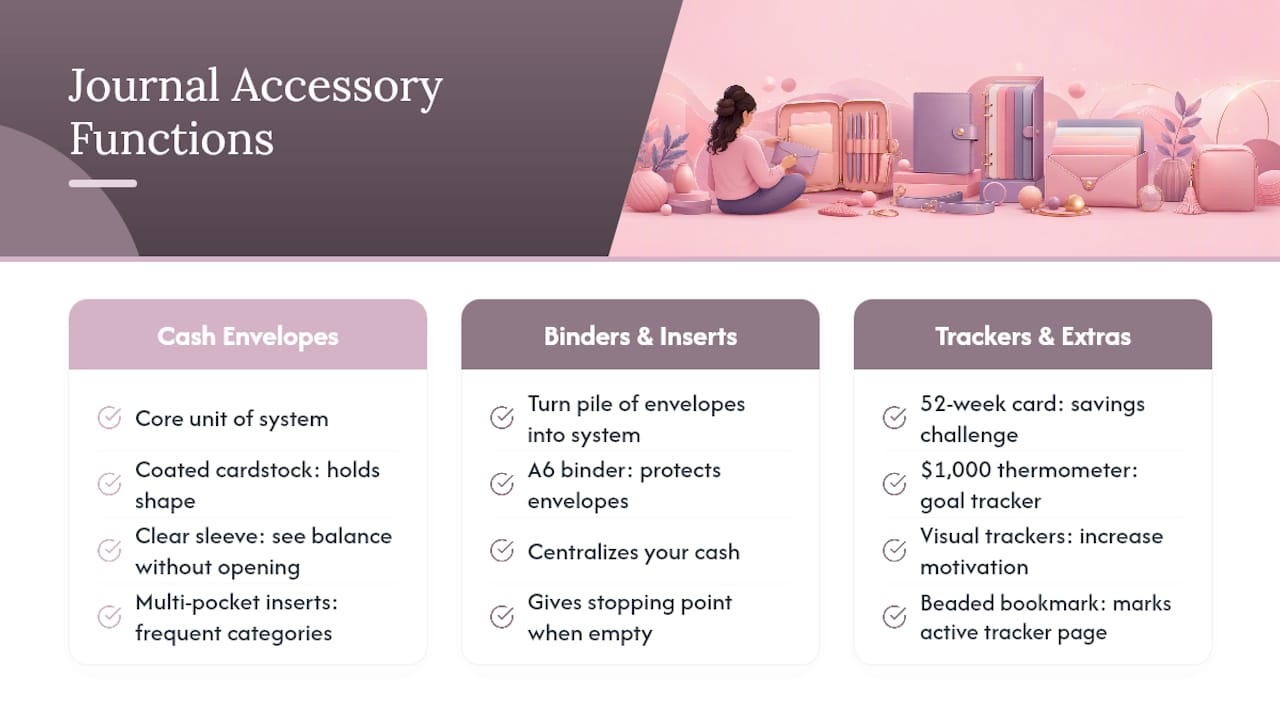
Cash-stuffing envelopes are the core unit. A coated cardstock envelope holds its shape through daily handling better than plain paper, while a clear plastic sleeve lets you see the balance without opening anything. Multi-pocket inserts (two or three pockets per page) work well for categories you check often, like groceries and gas. Single-sleeve envelopes suit sinking funds you touch less frequently, like car repairs or holiday gifts. Label the front with the category name and your monthly target amount.
Binders and inserts are what turn a pile of envelopes into a system. An A6 binder protects your envelopes from bending, centralizes your cash, and gives you a natural stopping point: when the envelope is empty, spending in that category stops. A ring binder lets you add or remove inserts freely; a zip binder keeps everything contained when you’re commuting.
Savings-challenge bundles add a goal layer on top of daily spending control. A 52-week challenge card or a $1,000 savings thermometer gives you something to color in or check off, and visual progress trackers like checkbox grids measurably increase motivation. Beaded paperclip bookmarks clip onto the active tracker page so you always open to the right spot.
Dividers, tab stickers, and a simple transaction tracker sheet round out the kit. The tracker sheet is the one most people skip and later regret. Keep it at the front of the binder.
Pro Tip: One label per spending category, and put your income overview sheet on the very first page. Every time you open the binder, you see the full picture before you touch a single envelope.
How do you choose the right size, material, and features?
A6 vs A7: start here
A6 fits paper cash without folding and slips into most handbags. A7 is genuinely tiny, suited only to someone who carries almost no cash and wants the smallest possible footprint. For most people, A6 is the right call.
Material trade-offs
Coated cardstock envelopes resist light moisture and hold printed labels well, but they will eventually show wear at the corners. Clear plastic sleeves are nearly indestructible and easy to wipe clean, though they feel less personal. Faux-leather binder covers handle daily bag-tossing without cracking and look polished enough to use at a coffee shop without embarrassment.
Refillability and pocket count
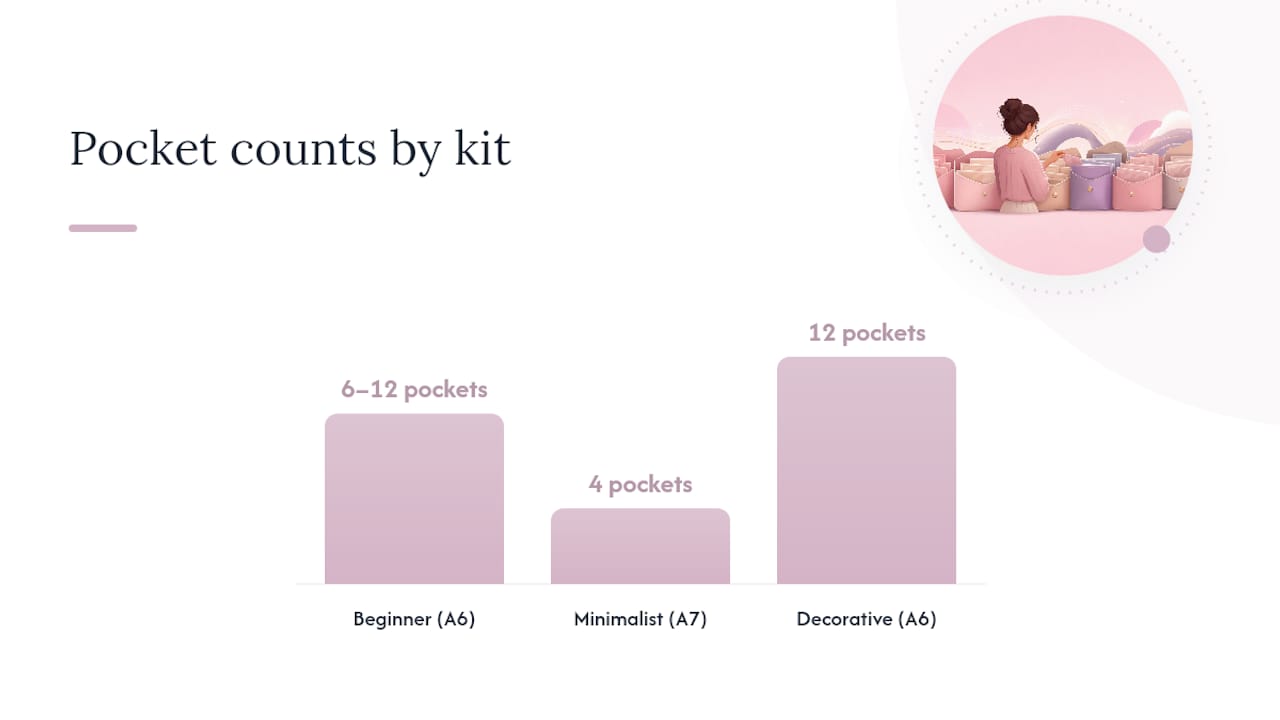
A starter kit typically needs 6–12 envelope slots. Multi-pocket inserts (three pockets per page) let you fit more categories into fewer pages, which matters in an A6 binder where space is limited. Confirm that replacement inserts are available before you buy a binder, because a non-refillable system becomes expensive fast.
| Best for | Size compatibility | Material & durability | Refillable / pockets | Price / value | Aesthetic options |
|---|---|---|---|---|---|
| Beginner | A6 | Coated cardstock | Yes / 6–12 pockets | $5–$15 | Neutral, printable labels |
| Minimalist | A7 | Clear plastic sleeves | Yes / 4 pockets | $5–$15 | Plain, monochrome |
| Decorative | A6 | Faux leather + handmade paper | Yes / 12 pockets | $30–$80 | Patterned, color-matched |
Pro Tip: Pick your binder size before you buy a single insert or envelope. A7 inserts will not fit an A6 ring system, and the reverse wastes space.
Which starter kit should you buy first?
Three kits cover the most common buyer types. Startup costs for a basic system run $5–$15; a full decorative setup typically lands in the $30–$80 range.
Kit 1 — Budget beginner ($5–$15)
- A6 ring binder (plain or lightly patterned cover)
- 6 clear plastic envelope inserts
- Printed tracker sheet and category labels
- Best for: someone trying cash-stuffing for the first time who wants to test the system before spending more
Kit 2 — Minimalist on-the-go ($10–$25)
- A7 zip binder
- 4-pocket inserts
- Plain printed labels
- One savings-challenge card
- Best for: a commuter or student who carries minimal cash and needs everything in a coat pocket; see cash-stuffing tips for students for low-budget category ideas
Kit 3 — Decorative enthusiast ($30–$80)
- A6 premium binder with faux-leather or patterned cover
- 12 handmade cash envelopes
- Savings-challenge bundle
- Beaded paperclip bookmarks
- Best for: someone who has already tried cash-stuffing and wants a setup they genuinely look forward to opening
Pro Tip: Start with Kit 1 to confirm the system works for your habits. Upgrade to Kit 3 once you’ve stuck with it for a full month. Pretty tools are worth the premium when you actually use them.
How do you run a cash-stuffing system week to week?
- Set your categories. Groceries, gas, dining out, personal care, sinking funds. Six to eight categories is enough to start. Check envelope category ideas if you need a prompt.
- Record every withdrawal on the tracker sheet inside the binder. A running log of what you spent and when is what separates cash-stuffing from just carrying cash. Weekly check-ins and daily transaction logs measurably increase financial awareness.
For online purchases, withdraw the equivalent cash from the relevant envelope and set it aside as a mental “spent” marker. It feels awkward the first time and automatic by the third week.
Savings-challenge bundles slot into the monthly rotation naturally and can be enhanced with tools for meeting each other well to share budgeting tips in small groups. Clip a beaded paperclip bookmark onto your active challenge page so it opens there automatically. Physical tools with simple two-minute updates drive consistent savings behavior better than apps for many people, precisely because the friction of opening a binder is a deliberate pause.
Pro Tip: Write the date next to every withdrawal on your tracker sheet. Patterns show up fast, and seeing “dining out: 4 withdrawals in 6 days” is more motivating than any app notification.
How do you keep handmade accessories in good shape?
- Keep envelopes and binders away from moisture; a single wet bag can warp coated cardstock permanently
- Wipe plastic sleeves with a soft, dry cloth; avoid paper towels, which scratch over time
- Don’t overstuff pockets; a bulging envelope stresses the seam and shortens its life
- Store spare envelopes flat, never rolled or folded
- Keep beaded paperclip bookmarks on a small card or in a zip pouch when not in use; loose beads tangle quickly
- Use a small fabric pouch around your binder when commuting to prevent corner dents
- Faux-leather covers wipe clean with a barely damp cloth; avoid alcohol-based cleaners
- Coated cardstock fades with prolonged sun exposure, so store the binder out of direct light
- Re-label envelopes with a fresh printed sticker rather than writing over old marker; it keeps the system looking clean and readable
Where should you buy handmade budgeting accessories in the U.S.?
Direct-shop sites like Mariaandherjournal offer the clearest product descriptions, accurate sizing information, and direct communication with the maker. You know exactly what you’re getting and can ask questions before ordering.
Curated marketplaces carry a wide range of handmade options, but quality varies significantly between sellers. Craft fairs are worth visiting if you want to handle materials before buying, though selection is limited and restocking is unpredictable.
Seller checklist before you buy:
- Materials and dimensions are clearly listed (not just “small” or “standard”)
- A6 or A7 compatibility is stated explicitly
- Pocket count per insert is specified
- Customer photos show real use, not just styled flatlays
- Domestic U.S. shipping is confirmed with an estimated timeline
- A return or exchange policy exists in writing
- Reviews mention durability and accurate sizing, not just aesthetics
| Channel | Pros | Cons |
|---|---|---|
| Direct-shop site | Accurate sizing, maker support, consistent quality | Smaller selection |
| Curated marketplace | Wide variety, buyer protection | Variable quality, sizing often vague |
| Craft fair | Handle before buying | Limited stock, no easy reorder |
Ask for exact measurements in millimeters if they aren’t listed. “Fits standard cash” is not a size.
Key Takeaways
The three accessories that make a cash-stuffing system work are a refillable A6 binder, labeled cash envelopes, and a savings-challenge bundle with beaded paperclip bookmarks.
| Point | Details |
|---|---|
| Three must-buys | A6 binder with inserts, labeled cash envelopes, and a savings-challenge bundle with beaded clips. |
| Sizing rule | Choose A6 for purse portability; A7 only if you carry very little cash and need the smallest possible size. |
| Buying rule | Prioritize material quality and refillability over trend aesthetics for long-term use. |
| Starter cost | A basic system runs $5–$15; a full decorative setup typically lands in the $30–$80 range. |
| Mariaandherjournal | Offers handmade beaded paperclip bookmarks and savings-challenge bundles designed for cash-stuffing binders. |
Why handmade tools change how budgeting feels
Most budgeting advice treats the tools as irrelevant. Get a spreadsheet, track your numbers, done. That framing misses something real: the physical act of opening a binder, counting cash, and clipping a bookmark onto a savings tracker creates a ritual. Rituals stick in a way that app reminders don’t.
Handmade accessories matter because they carry a kind of intention that mass-produced stationery doesn’t. When an envelope is cut and assembled by hand, or a paperclip is strung with beads one at a time, it signals that the person who made it thought carefully about how it would be used. That signal transfers to the person using it. You treat a beautiful, well-made tool differently than a generic one from a big-box store.
The customers who report the biggest improvements in budgeting consistency aren’t the ones who found the perfect spreadsheet formula. They’re the ones who built a system they actually want to open every day. Pretty, functional tools are not a luxury add-on to good budgeting. For many people, they’re the reason the system survives past the first month.
Handmade budgeting accessories from Mariaandherjournal
Handmade budgeting tools that you genuinely look forward to using are rare. Mariaandherjournal fills that gap with two collections built specifically for cash-stuffing systems.
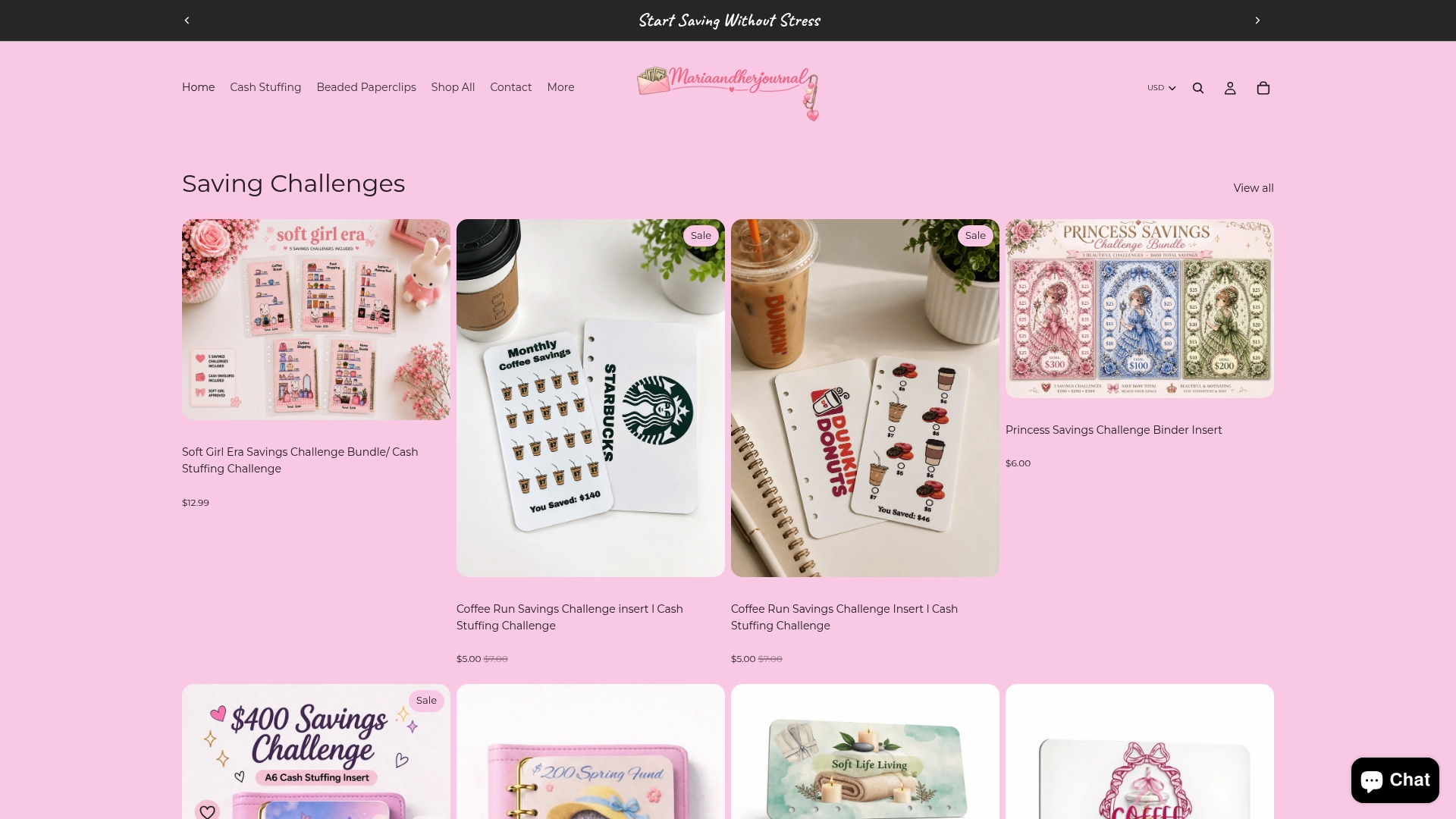
The beaded paperclip bookmarks are strung by hand and designed to clip onto binder pages without damaging inserts. They mark your active savings tracker, your weekly log, or any page you return to daily. The savings-challenge bundles slot directly into A6 binders and give you a visual, goal-driven tracker that works alongside your cash envelopes. Both collections ship domestically within the U.S.
Kit 3 buyers (decorative enthusiasts) will find the savings-challenge bundles pair naturally with a premium A6 binder setup. Kit 1 and Kit 2 buyers can start with just the beaded clips and add a challenge bundle once the system is running.
Browse both collections at mariaandherjournal.com and pick the bundle that matches your current savings goal.
Useful sources and further reading
- Cash Stuffing Binder Categories: Complete Setup Guide for Low Income (2026)
- Cash Stuffing: How to Start, What You Need, and Sample Budgets (2026) | Wealthvieu
- How To Budget Using Only A Paper Notebook | Biz Gate Financial
- Budgeting Notebook Ideas for Better Money Awareness - Beary Digitals
- Daily Planner Budgeting: Physical Tools for Savings | Tools4Wisdom -
- Beaded Paper Clips - MARIAANDHERJOURNAL
- Saving Challenges – MARIAANDHERJOURNAL
- A6 Binder Versus A7 Binder: Which Fits You? – MARIAANDHERJOURNAL