

The best christmas savings challenge for most people is the 20-week $1,000 envelope plan — it starts in July, ends right before Christmas, and asks for manageable weekly deposits that fit a typical paycheck. Your one step right now: grab 20 envelopes, label them $20 through $65 in the order that works for your budget, and put the first one’s cash aside today. If you want a ready-made kit instead of DIY, Mariaandherjournal’s saving challenges bundles come with printed trackers, labeled envelopes, and stickers so you can skip the setup entirely.
Quick picks by goal:
- $200 in 30 days: 30-day daily challenge, $3–$10 per day
- $500 in 10 weeks: $50 per week, steady and simple
- $1,000 in 20 weeks: Mixed-amount envelope plan starting in July
- $1,000 in 26 weeks: Incremental plan starting at $26/week, adding $1 each week
- $1,000 in 12 weeks: ~$83 per week, steady or momentum-builder style
- $2,000 in several months: Split into eight $250 milestones
- $1,378 in 52 weeks: Traditional $1-to-$52 ladder, starting January 1
Pro Tip: If you are starting mid-year and feel behind, skip the 52-week plan entirely. The 20-week or 26-week version was built for exactly that situation.
Key Takeaways
The most reliable way to finish a Christmas savings challenge is to match the plan length to your actual timeline, automate at least one deposit, and keep a visible tracker where you will see it every day.
| Point | Details |
|---|---|
| Pick the right timeline | Match your goal to a plan: $200 in 30 days, $500 in 10 weeks, $1,000 in 12–26 weeks, or $2,000 split into eight $250 milestones. |
| Adapt to your paycheck | Biweekly earners combine two weekly amounts per transfer; monthly earners add all four weekly amounts and move the total at the start of the month. |
| Automate and separate | Keep challenge money in a dedicated account or envelope set, and automate transfers on payday to remove the decision from the moment. |
| Use a visible tracker | A printed or handmade tracker you see daily feeds the progress cue that keeps you depositing through the middle weeks when motivation dips. |
| Mariaandherjournal bundles | Ready-made cash-stuffing kits with trackers, envelopes, stickers, and bookmarks ship within the US and remove all setup friction. |
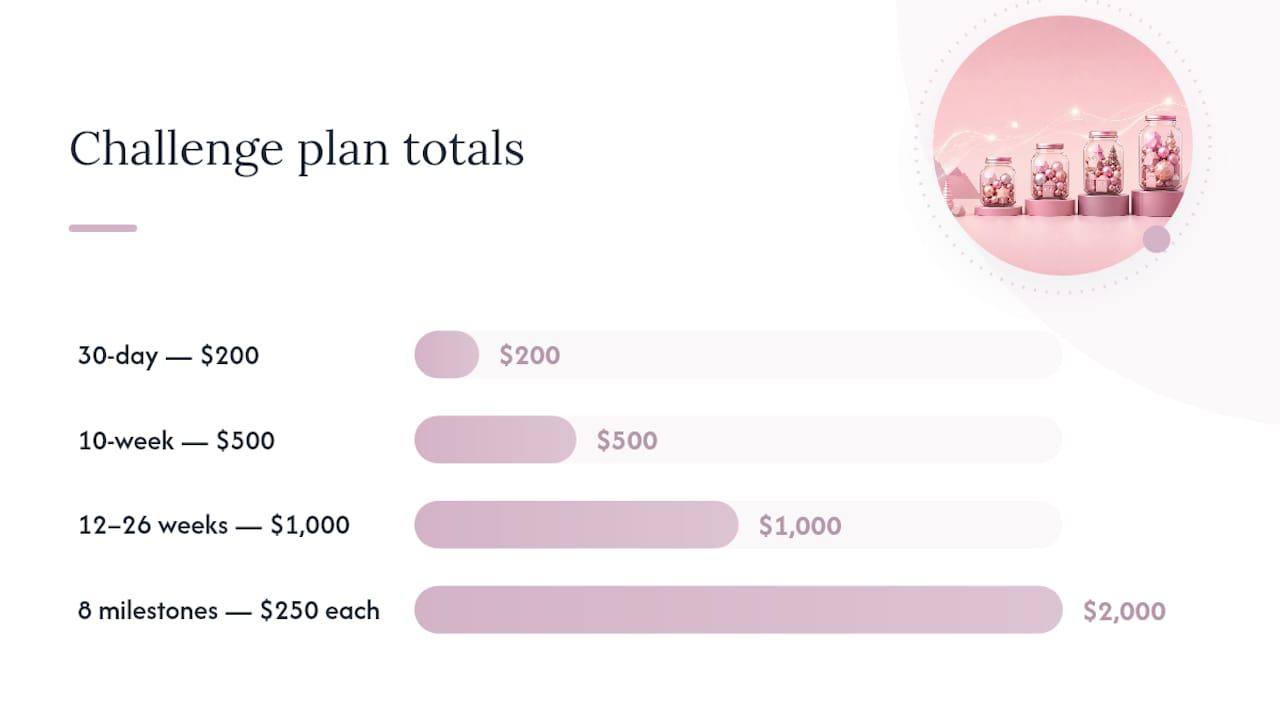
Table of Contents
- Which Christmas savings challenge fits your goal and timeline?
- Ready-to-use templates with exact weekly amounts
- How do the envelope method and digital automation compare?
- How do you adapt any plan to your pay schedule or catch up if you start late?
- Trackers, printables, DIY options vs buying a handmade bundle
- Behavioral tips and motivation hacks to finish the challenge
- Where should you keep your Christmas challenge money?
- Why handmade trackers and aesthetic tools increase completion rates
- How do you handle unexpected expenses without derailing your savings plan?
- How does goal-setting psychology help you stay committed to a savings challenge?
- What running a savings challenge actually taught me
- Mariaandherjournal’s handmade bundles make starting effortless
- Sources
Which Christmas savings challenge fits your goal and timeline?
The fastest way to pick a plan is to answer two questions: How much do you need? And how many weeks until Christmas? Once you have those numbers, the right challenge is obvious.
Match your goal to a plan:
- Under $300 and fewer than 6 weeks left: 30-day daily challenge
- $500 and 10 weeks: flat $50/week plan
- $1,000 and 12 weeks: steady-saver at ~$83/week or a momentum-builder that starts lower
- $1,000 and 20–26 weeks: envelope plan or incremental 26-week version
- $2,000 and 6+ months: split milestone plan
Beyond the dollar amount, your budget style matters. Three models cover most people:
- Steady saver: Equal deposits every week. Predictable, easy to automate, and good for people on a fixed income.
- Momentum builder: Small deposits early, larger ones later. Works well if your spending is heavier in spring and lighter in fall.
- Reverse (front-loaded): Largest deposits first, tapering down. Ideal if you get a tax refund or bonus early in the year and want to bank it fast.
Before you commit to any plan, run through this quick readiness check:
- Do you have a separate account or a set of envelopes ready to hold the money?
- Can you automate at least one transfer, or will you rely on manual deposits?
- Is your tracker visible somewhere you will actually see it daily?
If you answered no to any of those, fix it before week one. A plan without a container and a visible tracker rarely survives past the first missed deposit. For ideas that work even on a tight budget, the Mariaandherjournal guide on savings challenges for low income covers practical modifications.
Ready-to-use templates with exact weekly amounts
These templates cover the most common holiday savings goals. Pick one, print it or copy it into a tracker, and start.
52-week plan (traditional and November start)
The classic version runs January through December, depositing $1 in week one, $2 in week two, and so on up to $52, totaling $1,378. The adapted version starts November 1 and runs 52 weeks to the following Christmas, which gives you a full year without the pressure of starting on January 1.
For pay-schedule flexibility, the 52-week Christmas savings challenge groups weekly amounts into four envelope ranges: Envelope 1 covers weeks $1–$13, Envelope 2 covers $14–$26, Envelope 3 covers $27–$39, and Envelope 4 covers $40–$52. Pull from the right envelope on each payday instead of tracking individual weeks.
26-week $1,000 incremental plan
Start at $26 in week one, add $1 each week, and finish at $51 in week 26. The 26-week incremental plan reaches $1,001 by mid-December. Starting in late June gets you there right before Black Friday.
20-week $1,000 envelope plan
The 20-week envelope approach uses mixed weekly amounts across 20 labeled envelopes to reach $1,000. You can pull envelopes in order or randomly — random draws add a small element of surprise that many people find motivating.
12-week $1,000 plan
Two models work here. The steady-saver model deposits roughly $83.34 every week for 12 weeks. The momentum-builder model starts with smaller amounts in weeks one through four and increases through weeks five to twelve, so the heavier deposits land when holiday spending pressure is still weeks away.
10-week $500 plan
Flat $50 per week for 10 weeks. Simple enough to run without a printed tracker, though having one still helps.
30-day $200 daily challenge
Daily amounts run from $3 to $10, totaling $200 over 30 days. The plan is repeatable: run it twice back-to-back and you hit $400. Short challenges like this one work well as a supplement to a longer plan when you need a quick boost.
$2,000 split milestone plan
Divide $2,000 into eight sections of $250 each. Each section becomes its own mini-goal with a small reward when you hit it. Smaller weekly deposits inside each section keep the weekly ask from feeling steep.
Scaling any template: Multiply every weekly amount by 1.— to scale a $1,000 plan to $1,500, or halve the amounts to build a $500 version. For more challenge formats, the Mariaandherjournal roundup of money saving challenge examples covers additional variations.
Print or transfer: Download a tracker sized for 8.—×11, print on cardstock, and either tape it inside a budget binder or fold it to fit an envelope. Dated and undated versions both exist so you can start any week of the year.
How do the envelope method and digital automation compare?
Setting up the envelope system
The envelope savings challenge is physical and tactile: you label each envelope with a dollar amount, fill it with cash on deposit day, and watch the stack grow. Here is the setup in four steps:
- Decide on the number of envelopes your plan requires (20 for the 20-week plan, 26 for the 26-week version, and so on).
- Write the deposit amount on the front of each envelope. For random-draw plans, fold the envelopes so the amounts face inward and pull one blindly each week.
- Store the filled envelopes somewhere visible but secure: a dedicated box, a budget binder with pockets, or a small safe.
- Mark each envelope as “done” on your tracker once it is filled.
Family-friendly variation: let kids pull the random envelope each week. It turns a chore into a small event and builds money habits early.
Security note: Cash at home carries real risk. Keep filled envelopes out of plain sight, and consider a fireproof lockbox for larger totals. Never store the full challenge amount in a single location.
Running the challenge digitally
Open a dedicated savings account — ideally a high-yield savings account (HYSA) — and set up automatic transfers on payday. Automation is the single most reliable way to avoid missed deposits, especially on aggressive short timelines.
To simulate envelopes digitally, use a bank that offers sub-accounts or “savings buckets” (Ally, SoFi, and Capital One 360 all offer this feature). Label each bucket with a week number or milestone amount. Round-up apps can supplement your deposits by sweeping spare change into the fund automatically.
Pro Tip: Run a hybrid: use cash envelopes for the small weekly deposits so you feel the progress physically, and set one larger automatic transfer per month for the heavier amounts. You get the motivation of the physical system without the security risk of holding a large cash balance at home.
How do you adapt any plan to your pay schedule or catch up if you start late?
Converting weekly amounts to your pay schedule
Most challenge templates are written in weekly increments, but most Americans are paid biweekly or twice a month. The math is straightforward:
- Biweekly (every two weeks): Add the two weekly amounts that fall within each pay period and transfer the combined total on payday.
- Semi-monthly (1st and 15th): Divide your monthly target by two and transfer half on each payday.
- Monthly: Add all four weekly amounts for the month and transfer the total at the start of the month.
Example using the 26-week plan: Weeks 1 and 2 total $53 ($26 + $27). If you are paid biweekly, transfer $53 on that payday instead of splitting it across two weeks.
The 52-week envelope grouping method handles this automatically: each envelope group covers roughly one month of deposits, so monthly earners pull from one group per pay cycle.
Catching up after a late start or missed weeks
- Double up for two to four weeks: If you missed one week, deposit twice the normal amount the following week. Two missed weeks can usually be recovered in three to four weeks of slightly higher deposits.
- Reallocate discretionary spending: Identify one category (dining out, subscriptions, impulse buys) and redirect that money to the challenge fund for the catch-up period.
- Add a short side-income push: A weekend of selling unused items, one extra shift, or a small freelance gig can close a gap without touching your regular budget.
- Extend the end date by one to two weeks: If Christmas is still far enough away, a short extension beats burning out trying to catch up too fast.
One rule to keep in mind: avoid cuts so extreme that you abandon the challenge entirely. A smaller deposit is always better than no deposit. For more on maintaining a weekly savings challenge across a full year, Mariaandherjournal’s guide covers schedule adaptations in detail.
Trackers, printables, DIY options vs buying a handmade bundle
Free printables are everywhere, and they work fine if you print them correctly and actually use them. The gap between a free printable and a bought bundle is not the template itself — it is durability, aesthetics, and the extras that keep you engaged past week three.
Free printables: what to know
- Print on cardstock (65 lb or heavier), not standard copy paper. Thin paper tears at the folds and looks worn within weeks.
- Size your file for 8.—×11 before printing. Printable tracker files come in dated and undated versions; undated ones let you start any week without the tracker looking “wrong.”
- Laminate high-traffic trackers (the ones you handle daily) so they survive the full challenge.
- Tape or clip the tracker to the front of your envelope set or inside the cover of a budget binder.
DIY jar or binder tracker
Write amounts on small slips of paper, fold them, and drop them into a jar. Pull one slip per week, deposit that amount, and cross it off a master list. It costs almost nothing and works surprisingly well for visual learners who like seeing the jar empty out.
Buying a handmade bundle
Mariaandherjournal’s saving-challenge bundles include printed trackers, cash-stuffing envelopes, stickers, and handmade beaded paperclip bookmarks. The difference from a DIY kit is mostly feel: the materials are heavier, the design is cohesive, and the extras (stickers for milestone marking, bookmarks for your binder) make the whole system look like something worth maintaining. A savings challenges book or bound tracker also keeps all your envelopes and notes in one place, which matters when you are six weeks in and life gets busy.
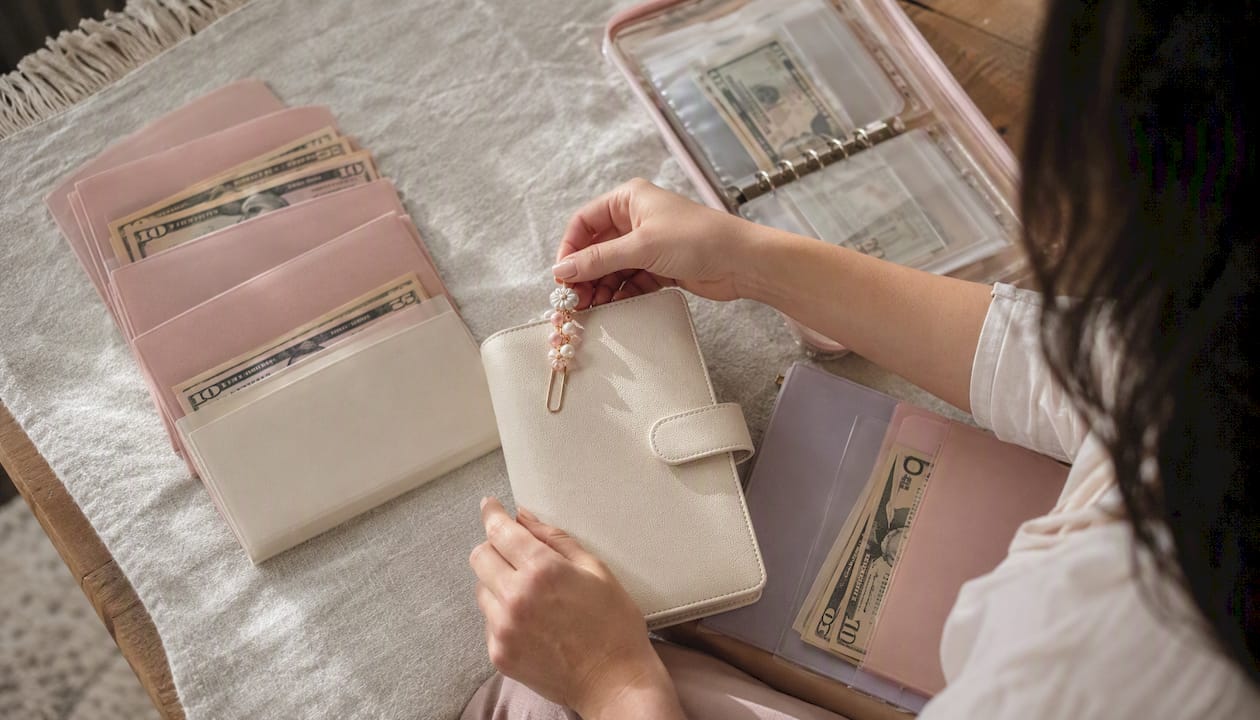
Pro Tip: If you are buying a bundle as a gift for someone starting their first holiday savings plan, the handmade kit removes every setup barrier. They open it, read the instructions, and start the same day.
Behavioral tips and motivation hacks to finish the challenge
The biggest reason people quit a savings challenge is not money. It is the loss of momentum around weeks four through six, when the novelty fades and the goal still feels far away.
What actually keeps people going:
- Visible progress: A tracker on your fridge or desk works better than one buried in a folder. You want to see the filled boxes every day.
- Milestone rewards: When you hit 25%, 50%, and 75% of your goal, mark it with something small: a favorite coffee, a movie night, anything that acknowledges the progress without spending the savings.
- Social accountability: Tell one person about your challenge. A partner, a friend, or an online community. Knowing someone will ask about your progress raises follow-through significantly.
- Calendar reminders: Set a recurring phone alert for deposit day. Treat it like a bill payment.
Practical money hacks to accelerate the fund:
- Redirect cashback rewards from credit cards directly to the challenge account.
- Use coupon savings as deposits: if a grocery run saves you $12, move $12 to the fund.
- Apply windfalls (tax refunds, birthday money, work bonuses) as lump-sum deposits.
- Pairing a recipient wishlist with your savings plan helps you set a realistic gift budget before you start, so you are not guessing at a target number.
When things go wrong:
- Missed a week? Deposit what you can and make up the rest over the next two weeks. Do not skip two in a row.
- Holiday spending temptation hits early? Keep the challenge account separate from your checking account so the money is not one tap away.
- Life event disrupts the plan? Pause for one week, not permanently. Resume with the next scheduled deposit.
Where should you keep your Christmas challenge money?
The right account is the one that keeps the money out of your everyday spending reach while still being accessible when Christmas arrives.
Your main options:
- High-yield savings account (HYSA): Earns more interest than a standard savings account and keeps the money separate from checking. Good for challenges lasting 12 weeks or more. Check current APYs before opening one, as rates vary by institution and change frequently.
- Separate sub-account at your current bank: Lower friction than opening a new account. Many banks let you nickname sub-accounts (“Christmas 2026”), which adds a psychological barrier to spending the money early.
- Christmas Club accounts: Some credit unions still offer these seasonal savings accounts that lock funds until November or December. They are less common than they were a decade ago, but worth asking about at your local credit union.
- Cash envelopes at home: Zero interest, but maximum visibility. Works best for shorter challenges (10–20 weeks) where the total stays under a few hundred dollars. Use a lockbox for amounts over $200.
A practical rule: the longer the challenge and the larger the goal, the more an HYSA makes sense. The automation approach — treating the transfer as a non-negotiable bill — works best when the account is at a different institution from your checking account, adding one extra step before you can spend it.
Short disclaimer: bank rates, account minimums, and Christmas Club availability change. Confirm current terms directly with your bank or credit union before opening an account.
Why handmade trackers and aesthetic tools increase completion rates
There is solid behavioral reasoning behind why a physical, well-designed tracker outperforms a spreadsheet for most people. Tactile progress, the act of filling in a box or sealing an envelope, activates the brain’s reward system in a way that a digital number updating silently in an app does not. You see the stack of filled envelopes. You feel the binder getting heavier. That feedback loop is what habit researchers call a “progress cue,” and it is one of the strongest predictors of whether someone finishes a savings challenge or abandons it.
Different audiences benefit from this differently:
- Families with kids: A visible jar or wall tracker turns saving into a shared activity. Kids who watch the progress tend to ask fewer times to spend the money.
- Single savers: A beautiful binder or printed kit on the desk makes the challenge feel personal rather than clinical. Aesthetics matter more than most financial advice acknowledges.
- Irregular-income workers: A physical envelope system lets you deposit whatever amount you can afford that week without reconfiguring a digital template. Pull the envelope that matches what you have; skip nothing.
Handmade budgeting tools work because they make the invisible visible. When your savings challenge lives in a beautiful printed binder with labeled envelopes and milestone stickers, it stops feeling like a chore and starts feeling like a project worth finishing. That shift in perception is what separates the people who reach their Christmas goal from the people who give up in October.
Mariaandherjournal’s bundles are built around exactly this principle: every element, from the tracker design to the beaded paperclip bookmarks, is chosen to make the system feel worth returning to every week.
How do you handle unexpected expenses without derailing your savings plan?
Unexpected expenses are the most common reason a holiday savings plan stalls. A car repair, a medical bill, or a broken appliance can wipe out two or three weeks of deposits in a single day.
The fix is not to save more aggressively before the expense hits. It is to build a small buffer into the plan from the start.
- Set aside a 10% buffer: If your goal is $1,000, aim to save $1,100. The extra $100 covers one or two disruptions without requiring you to restart.
- Keep a “pause week” in reserve: Decide in advance that you are allowed one no-deposit week per challenge without guilt. Knowing the escape valve exists makes it easier not to use it.
- Separate the emergency fund from the challenge fund: Never pull from Christmas savings for an emergency if you have any other option. Even a small $200–$300 emergency fund in a separate account protects the challenge money.
- Triage the expense: Ask whether the unexpected cost is truly urgent or whether it can be spread over two to three weeks. A non-urgent repair can often wait long enough for you to catch up on deposits first.
If a major expense genuinely forces a pause, resume the challenge at the next payday with the original weekly amount. Do not try to catch up all at once. Slow and steady still gets you to Christmas with more money than quitting does.
How does goal-setting psychology help you stay committed to a savings challenge?
The research on goal commitment points to one consistent finding: specific, written goals with a deadline outperform vague intentions by a wide margin. “Save for Christmas” is not a goal. “Save $1,000 by December 15 by depositing $50 every Monday” is.
Three psychological tools that work particularly well for savings challenges:
1. Implementation intentions Write down not just what you will do, but when and where. “Every Monday morning after I make coffee, I will move $50 to my Christmas account.” This if-then structure removes the decision from the moment, which is when willpower is most likely to fail.
2. Loss framing Reframe the challenge as protecting money you have already committed, not as giving up money you could spend. Once a deposit is made, it belongs to Christmas. Spending it early means taking from yourself, not from a future budget line.
3. Commitment devices Tell someone your goal. Write it on your tracker. Use an account that requires an extra step to withdraw. Every friction point between you and the money is a commitment device, and they work. The beginners’ savings challenge guide from Mariaandherjournal covers several of these techniques in a format that is easy to act on immediately.
One more thing that is underrated: celebrate the process, not just the outcome. Finishing week ten of a 20-week challenge is worth acknowledging. The people who reach their Christmas goal are usually the ones who made the weekly deposit feel like a small win, not a sacrifice.
What running a savings challenge actually taught me
The first time I ran a Christmas savings challenge, I chose the 52-week plan because it seemed the most organized. I quit in March. The amounts in the final weeks felt enormous compared to the early weeks, and by the time the big deposits arrived, I had already mentally spent the money on other things.
The second time, I switched to a 20-week envelope plan and started in July. The difference was immediate. Pulling a labeled envelope, filling it with cash, and dropping it into a binder gave me something the spreadsheet never did: a physical record of progress I could hold. By week eight, the binder was noticeably thicker. That sounds small, but it changed everything about how motivated I felt to keep going.
A handmade kit removes the friction of setup and adds the kind of aesthetic care that makes you want to return to the system. When your tracker is beautiful and your envelopes are labeled in a consistent hand, the whole challenge feels intentional rather than improvised. That feeling is what carries you through the weeks when motivation dips.
Mariaandherjournal’s handmade bundles make starting effortless
Handmade cash-stuffing kits from Mariaandherjournal give you everything in one package: printed savings trackers, labeled cash-stuffing envelopes, milestone stickers, and beaded paperclip bookmarks that keep your binder organized and genuinely pretty to look at. There is no cutting, no sourcing cardstock, and no hunting for the right template size.
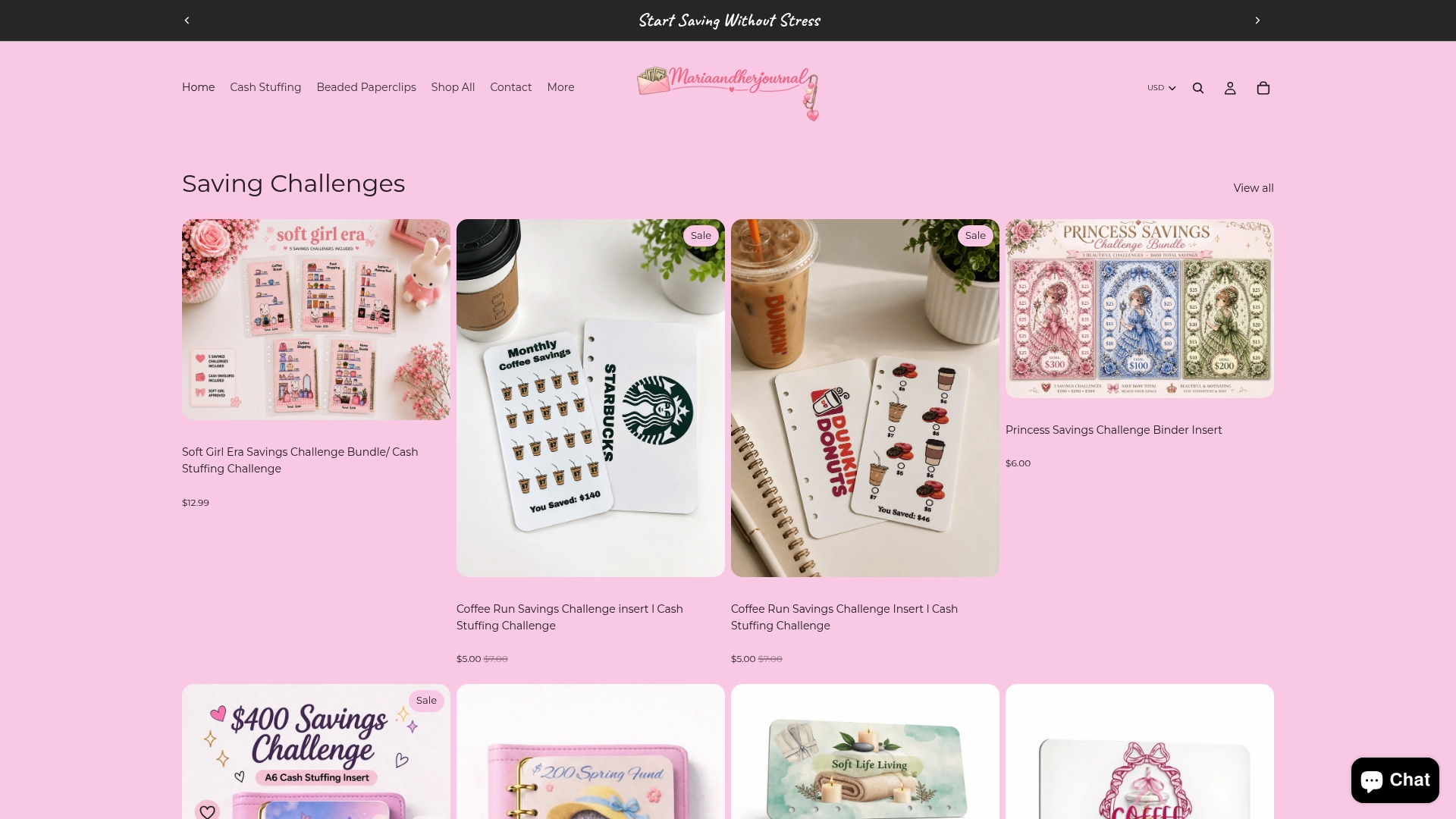
Every bundle ships within the US, and the Cash Stuffing Essentials collection includes kits sized for the most popular challenge lengths. The Saving Challenges collection covers specific goal amounts from $500 to $2,000, with tracker designs that match the envelope system. Occasional bundle discounts appear in the shop, so it is worth checking before you order. Browse the saving challenges collection and pick the kit that matches your goal — your first deposit can happen the same day it arrives.
Sources
Print everything at 8.—×11 on cardstock (65 lb or heavier). Before printing, confirm your PDF viewer is set to “actual size” rather than “fit to page” so the tracker dimensions stay accurate.
- Christmas Savings Challenge - How To Save $1,000 By Christmas!
- 26-Week and 56-Week Christmas Savings Challenge: Save $1,000 by Christmas - FinSavvy Panda
- 12 Week Challenge to Save 1000 Dollars for Christmas
- Christmas Savings Challenge Printables - It’s Always Autumn