

A coin savings challenge is a structured habit where you collect, track, and save physical coins (or their digital equivalent) over a set period, usually 30 days to a full year. The fastest way to start: pick one format from the list below, grab a jar, print or draw a simple tracker, and drop your first coins in tonight.
Here is what to have ready before you begin:
- A jar or container — any size works; a clear one lets you see progress
- A printable tracker (or a hand-drawn grid on paper)
- A dedicated spot near your door, desk, or nightstand where coins land naturally
- A cash-in plan — know whether you will roll coins, use a bank, or use Coinstar before you finish
Quick math on the three most popular formats:
- Penny-a-day (365-day): Start at $0.01 on day one, add one cent each day. Total: about six hundred sixty-seven dollars and ninety-five cents
- 52-week challenge: Save $1 in week one, $2 in week two, up to $52 in week 52. Total: $1,378
- Spare-change jar: Empty your pockets daily. Totals vary, but consistent cash users often collect $200–$400 in a year
Pick the format that fits your cash habits and income. Then read on for the full breakdown.
Key Takeaways
A coin savings challenge works best when you choose one format, keep your tracker visible, and know your cash-in plan before you finish collecting.
| Point | Details |
|---|---|
| Choose one format | Pick penny-a-day, 52-week, or spare-change jar based on your cash habits and income. |
| Use a visible tracker | A printed or laminated tracker on the fridge or desk is the single strongest habit anchor. |
| Know your cash-in plan | Call your bank before rolling coins; Coinstar’s gift-card option avoids the 11.9% cash fee. |
| Go hybrid if cash is rare | Pair a small jar with a $5–$10 weekly automatic transfer to keep accumulation consistent. |
| Mariaandherjournal bundles | Handmade savings bundles with trackers, envelopes, and paperclip bookmarks are available in the shop. |
Table of Contents
- Popular coin savings challenge formats and how much each saves
- What a printable tracker includes and how to build one
- Digital tools that replicate the spare-change habit
- How to convert your coins into usable money
- Habit tips that help you actually finish a coin savings challenge
- How a handmade bundle supports a 52-week challenge
- A word from Maria on small wins
- Ready-made savings bundles from Mariaandherjournal
- Sources
Popular coin savings challenge formats and how much each saves
These are the formats readers actually complete, ranked roughly from lowest to highest commitment. Each one has a realistic total and a short note on who it fits best.
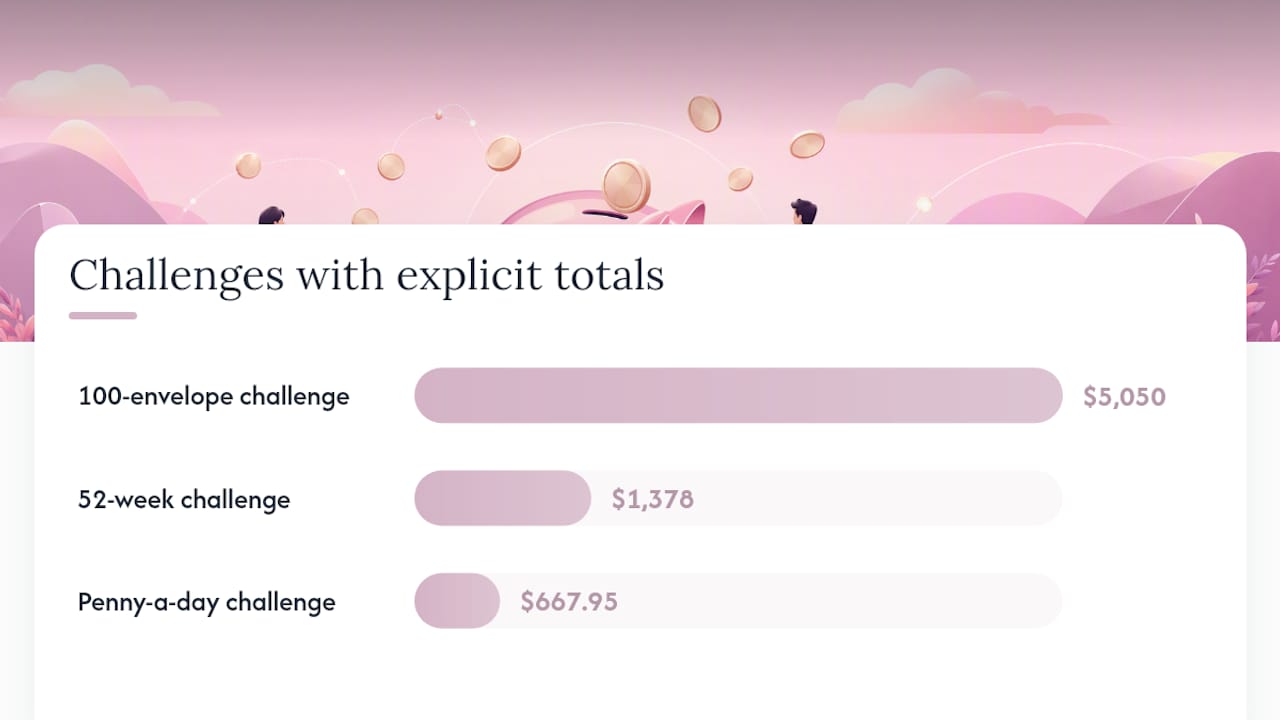
1. Penny-a-day challenge (365 days) Start with one cent on January 1 and add a penny each day. By December 31 you have saved $667.95. The early weeks feel almost too easy (day 30 is only $0.30), which is exactly the point: the habit forms before the amounts get noticeable. Best for beginners and anyone who has quit challenges before because the early deposits felt too large.
2. 52-week savings challenge Week one: $1. Week two: $2. Week 52: $52. The 52-week challenge saves $1,378 when followed as described. One common adaptation: reverse it, starting at $52 in January when motivation is high and finishing at $1 in December when holiday spending peaks. Best for people who want a meaningful year-end total and can handle rising weekly deposits.
3. Spare-change jar No schedule, no math. Every coin from your pocket, purse, or car cupholder goes in the jar. Totals depend entirely on how much cash you handle, so amounts vary by individual. The habit is the lowest-friction of any format. Best for cash-heavy households and families who want a shared project.
4. Denomination tracker Choose one coin type (quarters only, for example) and save every one you receive. A full jar of quarters runs roughly $10 per pound. Best for people who want a single, simple rule with no spreadsheet.
5. 100-envelope challenge Label 100 envelopes numbered 1 through 100. Each day, pull a random envelope and fill it with that dollar amount. The 100-envelope challenge saves $5,050 over 100 days. The randomness keeps it interesting, though the higher-numbered envelopes require real cash on hand. Best for motivated savers who want a shorter timeline and a bigger payoff.
6. Monthly coin challenge Set a fixed coin goal per week (say, $5 in coins) and track it on a simple grid. Lower stakes than the 52-week format, easier to restart if you miss a week. Best for low-income savers or anyone who wants a gentler starting point.

7. Envelope denomination variant Use labeled envelopes for each coin type (pennies, nickels, dimes, quarters) and fill one envelope per week. When all four are full, cash them in and restart. Adds a tactile, sorting element that many people find satisfying. Best for families with kids who want to learn coin values while saving.
What a printable tracker includes and how to build one
A good tracker does two things: it tells you exactly what to deposit and shows you how far you have come. Printable trackers remain popular precisely because visible progress is one of the strongest motivators to keep going.
The fields that matter most on any tracker:
- Denomination columns (pennies, nickels, dimes, quarters, or dollar amounts by week)
- Checkboxes or fill-in circles for each deposit so you can mark it done
- Running total column updated after each entry
- Weekly subtotal row to see momentum at a glance
- Target date and goal amount at the top so the finish line is always visible
- A simple progress bar or thermometer graphic you color in as you go
To customize a template, decide first whether it is single-use (print a fresh sheet each month) or reusable (laminate it and use a dry-erase marker). A reusable sheet saves paper and works well for repeating monthly challenges. For a 52-week format, a single landscape-oriented page with 52 numbered rows fits neatly on one sheet.
DIY in three steps: sketch your grid in a free tool like Canva or Google Sheets, add your denomination columns and a progress bar, then export as a PDF and print at home. Cardstock holds up better than regular paper if you handle it daily.
Pro Tip: Laminate your tracker after printing and use a fine-tip dry-erase marker to fill in amounts. When the challenge ends, wipe it clean and reuse it next year. Reusable sticker tabs work just as well if you prefer not to laminate.
A physical tracker or booklet increases follow-through because it creates a small ritual around each deposit, something a spreadsheet rarely does.
Digital tools that replicate the spare-change habit
If you rarely use cash, a physical jar will fill slowly. The good news: round-up apps reproduce the same micro-saving behavior automatically. Bank of America notes that savings challenges work by retraining behavior, and round-up tools do exactly that without requiring coins.
How round-up saving works in practice:
- You spend $3.60 on coffee; the app rounds up to $4.00 and moves $0.40 to savings
- Transfers happen automatically after each transaction or in daily/weekly batches
- Some apps invest the rounded-up amount; others hold it in a savings account
Three commonly cited tools:
- Acorns — rounds up linked debit or credit purchases and invests the difference; charges a monthly fee starting at $3
- Chime — rounds up debit purchases to the nearest dollar and transfers the difference to a savings account; no monthly fee for the round-up feature
- Qapital — lets you set custom rules (round up, save a fixed amount on payday, save when you skip a purchase); subscription-based
| Dimension | Spare-change jar | Round-up app |
|---|---|---|
| Effort | Empty pockets daily | Near zero after setup |
| Visibility | High (you see the jar) | Low (background process) |
| Expected annual amount | $200–$400 (cash users) | Varies by spending volume |
| Best for | Cash-heavy households | Card-first households |
Pro Tip: Before committing to any round-up app, check three things: the monthly fee, whether the linked account is a checking or credit account, and whether transfers are instant or batched weekly. A $3/month fee erases roughly $36 a year in savings, which matters on a small challenge total.
For cash-light households, the most reliable approach pairs a small physical jar with a modest automatic weekly transfer, so you get both the tactile habit and the consistent accumulation.
How to convert your coins into usable money
Collecting coins is the easy part. Cashing them in without losing a chunk to fees takes a little planning.
- Sort your coins by denomination into separate piles or small bowls
- Roll them using paper coin wrappers (free at most banks): pennies in 50-cent rolls, nickels in $2 rolls, dimes in $5 rolls, quarters in $10 rolls
- Call your bank first — ask whether they accept rolled coin deposits, loose coin deposits, or offer free coin counting for account holders. Policies vary widely by institution
-
Choose your cash-in method:
- Bank deposit (rolled coins): Usually free for account holders; some branches require an appointment for large amounts
- Coinstar (cash option): Charges an 11.9% fee on the total; on $500 that is nearly $60 lost
- Coinstar (gift card or charity voucher): No fee; a smart option if you want an Amazon or other retailer credit
- Credit union coin counters: Many credit unions offer free counting for members
- Deposit or spend immediately — coins sitting in a rolled stack after cashing in tend to get raided for small purchases
Pro Tip: Call your bank before you roll a single coin. Some branches no longer accept rolled deposits and require loose coins in a bag; others do the opposite. Knowing the policy in advance saves you from re-rolling everything at the counter.
Habit tips that help you actually finish a coin savings challenge
Most people who quit a savings challenge do so in weeks three through six, not because the amounts are too large but because the habit never fully formed. Personal finance experts point out that the real benefit of a coin challenge is the “saving-first” mindset it builds, not the dollar total at the end. That reframe matters: if you think of the challenge as practicing a behavior rather than chasing a number, a missed week feels like a small stumble rather than a failure.
Adherence tactics that work:
- Stack it onto an existing habit — empty your pockets into the jar every time you take off your shoes at the door
- Pair deposits with payday — on the day money hits your account, make your weekly challenge deposit first, before any discretionary spending
- Put the jar somewhere you cannot ignore — a kitchen counter or bathroom shelf beats a closet shelf every time, as ANZ’s spare-change research confirms
- Review your tracker weekly — five seconds of looking at your progress bar is often enough to keep the streak alive
- Celebrate small milestones — when you hit 25% of your goal, do something small and free to mark it (a favorite meal, a walk, anything that signals “I did that”)
- Add social accountability — tell one person your goal or do the challenge alongside a friend or family member
Bank of America’s savings-challenge research frames challenges as behavior-retraining tools. The habit you build in month one is the real asset, not the coins in the jar.
Pro Tip: If you use a card more than cash, set a small automatic weekly transfer ($5–$10) to a separate savings account to run alongside your jar. It closes the gap between what you expected to collect in coins and what you actually have on hand, and it keeps the challenge feeling real even in a cashless week.
For more challenge-saving tips that stick, the behavioral side of the habit is where most guides underinvest.
How a handmade bundle supports a 52-week challenge
A 52-week challenge kit works best when every piece of it lives together. Here is a practical setup that Mariaandherjournal customers use:
- A printed and laminated 52-week tracker with weekly deposit amounts pre-filled, hole-punched to fit a budget binder
- Labeled cash-stuffing envelopes for each month, so rolled coins or transferred cash stay organized by period
- Decorative paperclip bookmarks to mark the current week in the tracker and keep the binder open to the right page
- Sticker labels for each envelope (month name, target amount, actual amount deposited)
The visual element matters more than it sounds. When your tracker is attractive and your envelopes are labeled and tidy, opening the binder feels like a small reward rather than a chore. That friction reduction is what keeps the habit alive past week six.
Mariaandherjournal’s handmade products, including cash-stuffing envelopes, savings bundles, and beaded paperclip bookmarks, are designed specifically for this kind of setup.

A word from Maria on small wins
The savers who finish a coin challenge are rarely the ones who started with the most motivation. They are the ones who made it easy to show up on a Tuesday when nothing felt exciting. A visible jar, a tracker on the fridge, a single rule about where coins go when you walk in the door: that is the whole system.
The satisfaction of coloring in one more box on a tracker is not trivial. It is the feedback loop that keeps the habit running. Start smaller than you think you need to, make the tracker visible, and let the process do the work.
Ready-made savings bundles from Mariaandherjournal
Putting together a tracker, envelopes, and accessories from scratch takes time. Mariaandherjournal’s handmade savings challenge bundles give you everything in one place, already designed to work together.
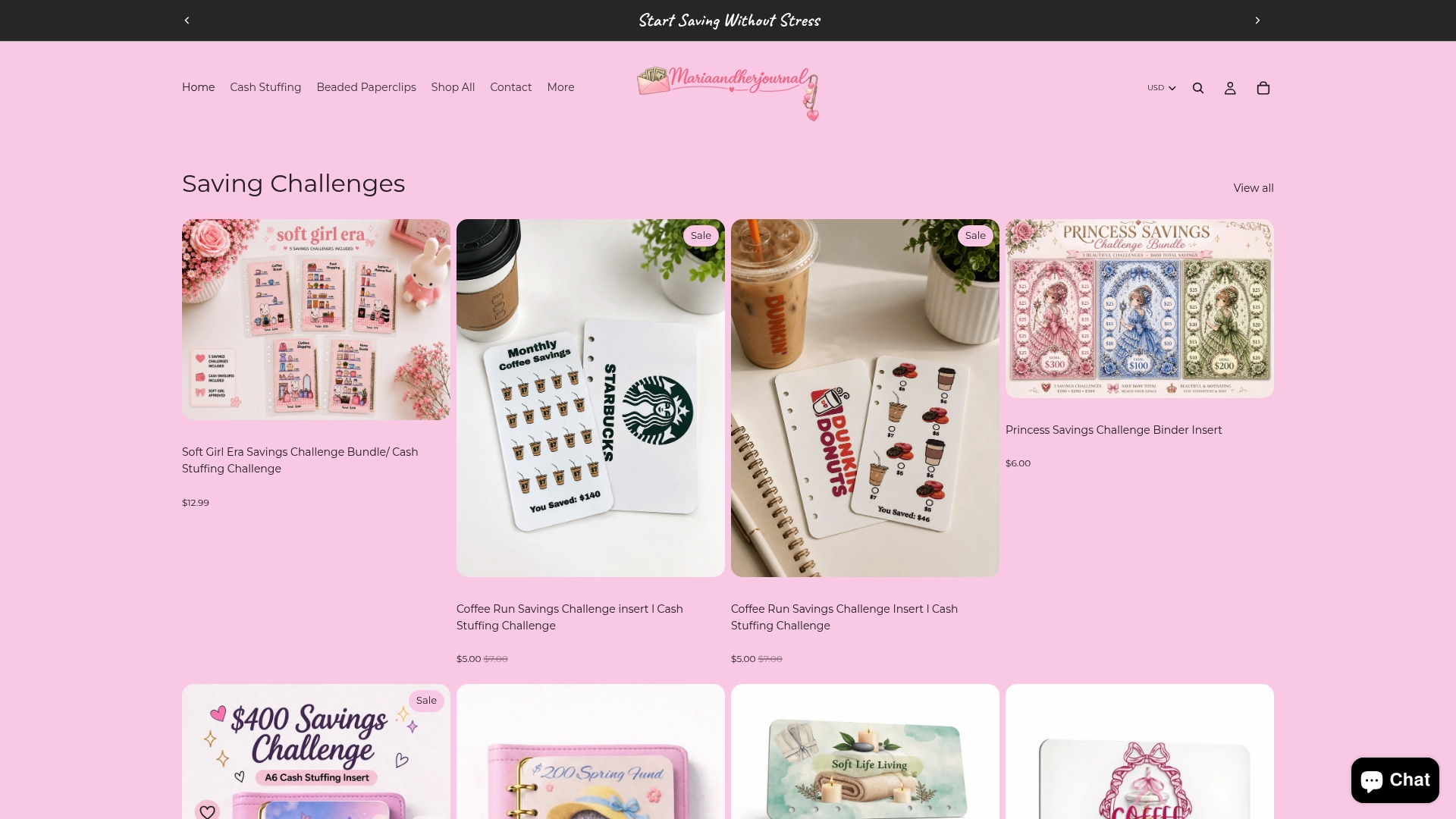
Each bundle includes a printable tracker with denomination columns and a progress bar, matching cash-stuffing envelopes sized for coin rolls and folded bills, and handmade beaded paperclip bookmarks to keep your binder organized. Everything is made by hand, which means no two sets are identical and the quality shows in the details.
If you want to try before you commit, browse the shop for individual tracker sheets or starter sets. The savings challenge collection is the best place to start.
Sources
- Money saving challenges that will teach you how to save | Better Money Habits (Bank of America)
- What’s the spare change challenge and does it even work? | GoBankingRates
- Money saving challenges to try in 2025 | PNC
- The spare change challenge: does it even work? | Yahoo Finance
- The spare change challenge | ANZ