

A coloring savings challenge is a printable tracker where each segment you color in represents a dollar amount you’ve saved. Pick a template, divide your goal by the number of segments, deposit that amount, then color one section. Mariaandherjournal offers ready-made savings challenge bundles so you can skip the setup and start coloring today.
Key Takeaways
A coloring savings challenge works because it turns an abstract number into a visual, segment-by-segment record of real progress you can see and touch.
| Point | Details |
|---|---|
| Pick the right template | Match segment count to your timeline: 20-segment for sprints, 50 or 100 for longer goals. |
| Map colors to dollars first | Divide your total goal by the number of segments before you start, and write the value on the sheet. |
| Automate deposits | Schedule a recurring transfer; color the segment when the transfer clears, not when you remember. |
| Keep the tracker visible | Post it on the fridge or in your planner so progress stays top of mind every day. |
| Mariaandherjournal bundles | Instant-download, binder-ready printables in A4, A5, and A6 sizes with built-in dollar mapping. |
Table of Contents
- What a coloring savings challenge is and who it’s for
- Why coloring-style trackers help you save more
- How to use a coloring savings challenge step by step
- Popular coloring challenge templates with real dollar mappings
- Where to find printable color-in savings trackers
- How to customize and print your tracker so it lasts
- Practical tips to keep your coloring challenge going
- Why Mariaandherjournal’s savings-challenge printables stand out
- A note from Maria on why these trackers exist
- Mariaandherjournal’s savings-challenge bundles are ready when you are
- Sources
What a coloring savings challenge is and who it’s for
At its core, a coloring money challenge is a visual savings tracker, usually a one-page printable, where every colored area equals a specific dollar amount saved. Fill in all the segments and you’ve hit your goal. No spreadsheet, no app, no mental math mid-month.
The format suits visual learners best, but it works for almost anyone who struggles to stay motivated with a plain number in a bank account. Parents use them to teach kids about saving. Beginners find them less intimidating than a full budget. People with variable income love them because many templates let you color any segment in any order, so a slow week doesn’t break the system.
Common formats include grid-style sheets (50 or 100 boxes), thermometer or progress-bar trackers, jar and coin-icon designs, and I‑Spy icon sheets where each icon type carries a fixed dollar value. The alphabet savings challenge is another popular variation, assigning a dollar amount to each letter so you save whenever you encounter that letter in daily life.

Why coloring-style trackers help you save more
The mechanism is simple: you see progress. Each colored segment is a tiny, visible win, and that visual feedback keeps the habit alive between deposits.
Key benefits:
- Micro-rewards on every deposit. Coloring a segment gives your brain a small, immediate payoff, which reinforces the saving behavior before the long-term reward ever arrives.
- Progress feels real. A half-colored thermometer communicates “I’m halfway there” faster than a bank balance ever could.
- Flexible for variable income. Icon-based and mystery-sum designs let you save at your own pace without a fixed weekly obligation, which makes them easier to sustain during irregular pay periods.
- Family-friendly. Kids can participate, which turns saving into a shared household activity rather than a solo chore.
- Works for any goal size. A 20-segment sheet suits a short sprint; a 100-box grid handles a year-long goal. The math scales with you.
- Habit stacking is easier. Attaching the coloring moment to an existing routine (payday, Sunday evening, morning coffee) builds the habit faster than a reminder app.
Short-term goals, like saving $400 for a holiday gift fund, benefit from smaller grids that fill up quickly and deliver that completed-page satisfaction within weeks. Longer goals, like a $5,000 emergency fund, need a larger template that shows cumulative progress without feeling endless.
How to use a coloring savings challenge step by step
- Set your total goal. Pick a specific dollar amount with a deadline. “Save $500 by August” is actionable; “save more money” is not.
- Choose a template. Match the number of segments to your timeline. A 50-circle printable works well for medium goals; a 100-box grid suits larger ones.
- Map colors to dollars. Divide your goal by the number of segments. $500 ÷ 50 circles = $10 per circle. Write that value on the sheet before you start.
- Decide your deposit schedule. Weekly, biweekly, or per-paycheck all work. For variable income, commit to “color whenever I deposit” rather than a fixed day.
- Make the deposit, then color. The physical act of coloring happens after the money moves. That sequence matters: the reward follows the behavior.
- Track exceptions. Missed a week? Don’t skip the segment; catch up with a double deposit the next period or color two segments when income allows.
- Celebrate the finish. When the sheet is fully colored, acknowledge it. Take a photo, share it, or keep the completed page in a savings challenges book as a record of what you’ve built.
For flexible scheduling, the I‑Spy format is worth noting: each icon type maps to a fixed amount, and you choose which icon to “find” each time you save. No required order, no penalty for gaps.
Popular coloring challenge templates with real dollar mappings
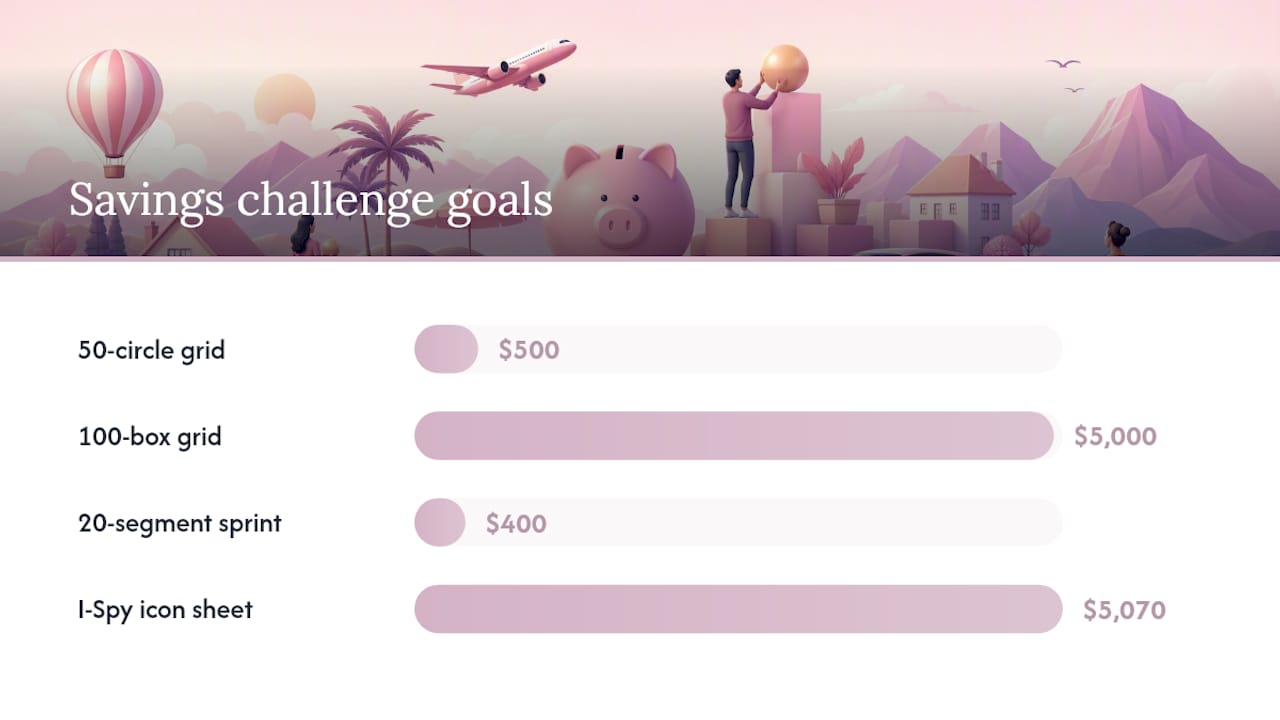
50-circle grid Divide any goal by 50 for your per-circle value. a common example is $10 per circle for a moderate savings goal. $1,000 = $20 per circle. Timeline: save one circle per week and you’re done in just under a year; save daily and you finish in 50 days.
100-box grid Best for larger goals. $5,000 = $50 per box. $2,600 = $26 per box (one per week for a year). Fixed-salary savers do well here because the uniform amounts are easy to automate.
20-segment sprint sheet Designed for short-term goals. $400 ÷ 20 segments = $20 per segment. Save $20 a day and the sheet is complete in 20 days. This is the fastest format for seasonal goals like a holiday fund or a car repair buffer.
Thermometer/progress bar Good for goals where deposits vary in size. Color up to the nearest line after each deposit.
Jar and coin-icon sheets Each coin or jar section equals a set amount. Visually satisfying because the jar “fills up” as you save. Popular with kids and beginners.
I‑Spy icon sheet Each icon type carries a fixed dollar value. Completing all icons reaches a a target sum over five thousand dollars, or $10,140 if you double the per-icon values. No fixed schedule required, which makes it the best pick for freelancers and gig workers.
Pro Tip: For variable income, use the I‑Spy or mystery-sum format and keep a small “savings float” in a separate account. When a good week hits, color multiple icons at once. The sheet still fills up, just not on a predictable schedule.
| Template | Sample goal | Per-segment value | Sample timeline |
|---|---|---|---|
| 50-circle grid | $500 | $10 per circle | 50 days (daily) or ~1 year (weekly) |
| 100-box grid | $5,000 | $50 per box | 100 weeks (~2 years) or 100 days |
| 20-segment sprint | $400 | $20 per segment | 20 days |
| I‑Spy icon sheet | $5,070 | Varies by icon | Flexible, no fixed schedule |
Where to find printable color-in savings trackers
Free printables are easy to find on personal finance blogs and community boards. The trade-off is quality: file resolution is often low, dollar mappings may be missing, and there’s no guarantee the page size matches your printer.
Paid bundles from publishers like Mariaandherjournal cost a few dollars but come with clear mappings, multiple size options, and instant download. For most people, the time saved on formatting alone is worth it.
Before downloading anything, check:
- File type. PDF is the safest for home printing. SVG files need design software to resize.
- Page size. US Letter (8.5 × 11 in) prints without scaling issues on most home printers. A4 and A6 sizes are common in bundles designed for binders.
- Resolution. 300 DPI minimum for crisp lines. Lower resolution looks blurry when printed.
- Dollar mapping. A good printable shows the per-segment value or leaves a clearly labeled write-in field. Blank sheets with no guidance are harder to use consistently.
- Licensing. Personal use is standard. If you’re printing for a classroom or group, check whether the license covers multiple copies.
- Instant download vs. physical ship. Digital downloads are ready in minutes. Physical products ship on a timeline, so check processing time before ordering for a time-sensitive goal.
Credibility signals worth looking for: sample images of the actual printed sheet, customer reviews mentioning print quality, and a clear description of what’s included in the file. Mariaandherjournal’s printable guidance covers these checks in detail.
How to customize and print your tracker so it lasts
A printed tracker you love looking at is one you’ll actually use. A few small choices at the printing stage make a big difference.
Printing checklist:
- Use at least 24 lb paper (standard copy paper is 20 lb and feels flimsy for something you’ll handle daily).
- Print at 100% scale, not “fit to page,” to preserve the segment sizes.
- For a black-and-white printer, choose a template with bold outlines so colored pencil or marker shows up clearly.
- Print a test page first to confirm alignment before using your good paper.
Customization ideas:
- Write your per-segment dollar value directly on the sheet before printing, or add it in pen after.
- Color-code by priority: use one color for “already saved” and a second color for “deposited but not yet cleared.”
- Add stickers or washi tape borders to make the tracker feel personal and worth displaying.
- Resize A4 sheets to A6 for binder inserts. Most PDF viewers let you print multiple pages per sheet to hit A6 size.
Durability options:
- Laminate the sheet and use dry-erase markers. Wipe clean and reuse the same tracker for a new goal.
- Slip the page into a sheet protector and use a fine-tip dry-erase marker on the outside.
- Store completed trackers in a dedicated budget binder with A6 binder pockets for portability and a motivating record of past wins.
Pro Tip: Laminate two copies: one as your active tracker (dry-erase), one as a permanent record once the goal is complete. The permanent copy goes in your binder; the active one resets for the next challenge.
Practical tips to keep your coloring challenge going
Momentum is the hardest part. The first week is easy; week six is where most people stall.
- Automate the deposit first. Set a recurring transfer to your savings account on payday. Color the segment when the transfer clears, not when you remember to do it manually. This removes the decision entirely.
- Place the tracker where you’ll see it. Fridge, planner cover, or bathroom mirror. Out of sight genuinely means out of mind for habit-based goals.
- Stack it with an existing habit. Color the segment right after you check your bank balance on Sunday, or right after you make your morning coffee. The existing habit carries the new one.
- Use micro-goals. Celebrate the 25% mark, not just the finish line. A small non-monetary reward (a favorite snack, a movie night) at each quarter keeps the motivation fresh.
- Try a buddy challenge. Share your tracker photo with a friend doing their own challenge. Accountability doesn’t require sharing dollar amounts; just showing a colored-in sheet is enough.
- Round-up rules help. Many banks offer automatic round-up savings on debit purchases. Let those micro-deposits accumulate, then color a segment once you’ve hit the per-segment value.
The weekly savings challenge format pairs especially well with automation: one transfer per week, one segment colored per week, and a fully colored sheet at year’s end.
Why Mariaandherjournal’s savings-challenge printables stand out
Mariaandherjournal designs its savings-challenge bundles specifically for people who want a tracker that’s both functional and worth displaying. The bundles include multiple printable sheet designs, clear per-segment labeling, and binder-ready sizing options (A4, A5, and A6), so you’re not stuck with one format.
What’s included in a typical bundle:
- Multiple coloring tracker designs (grid, thermometer, jar, and icon styles)
- Pre-labeled dollar mapping fields or write-in spaces
- Binder-ready A6 sizing that fits standard A6 binder pockets
- Instant digital download, available immediately after purchase
- US Letter and A4 print options in the same file
The A6 sizing is worth calling out specifically. Storing your active tracker in an A6 binder pocket means it travels with your budget binder, stays protected, and stays visible. Completed sheets stack neatly in the same binder as a motivating record of every goal you’ve finished.
Customers report that having a visually appealing tracker makes them more consistent, because the sheet itself feels like something worth completing rather than a chore to check off. The full collection of savings challenge ideas on the Mariaandherjournal blog also gives readers 15 formats to explore before committing to one.
A note from Maria on why these trackers exist
Designing these printables started with a simple frustration: most savings tools are either too clinical (a spreadsheet) or too vague (a generic goal-setting app). A coloring tracker sits in the middle. It’s tactile, it’s visual, and it gives you something to do the moment money moves into savings.
If you’ve never tried a color-in tracker, the easiest entry point is a single 20-segment sheet with a small goal, something like $200 in 20 days at $10 per segment. Print it, tape it to your fridge, and color the first segment today. That one colored circle does more for your motivation than any app notification. Browse the savings challenges collection to find a design that fits your goal and your style.
Mariaandherjournal’s savings-challenge bundles are ready when you are
Skipping the setup is the fastest way to start. Mariaandherjournal’s savings-challenge bundles give you print-ready tracker sheets in multiple designs and sizes, with dollar mapping already built in. No design work, no formatting, no guessing whether the file will print correctly.
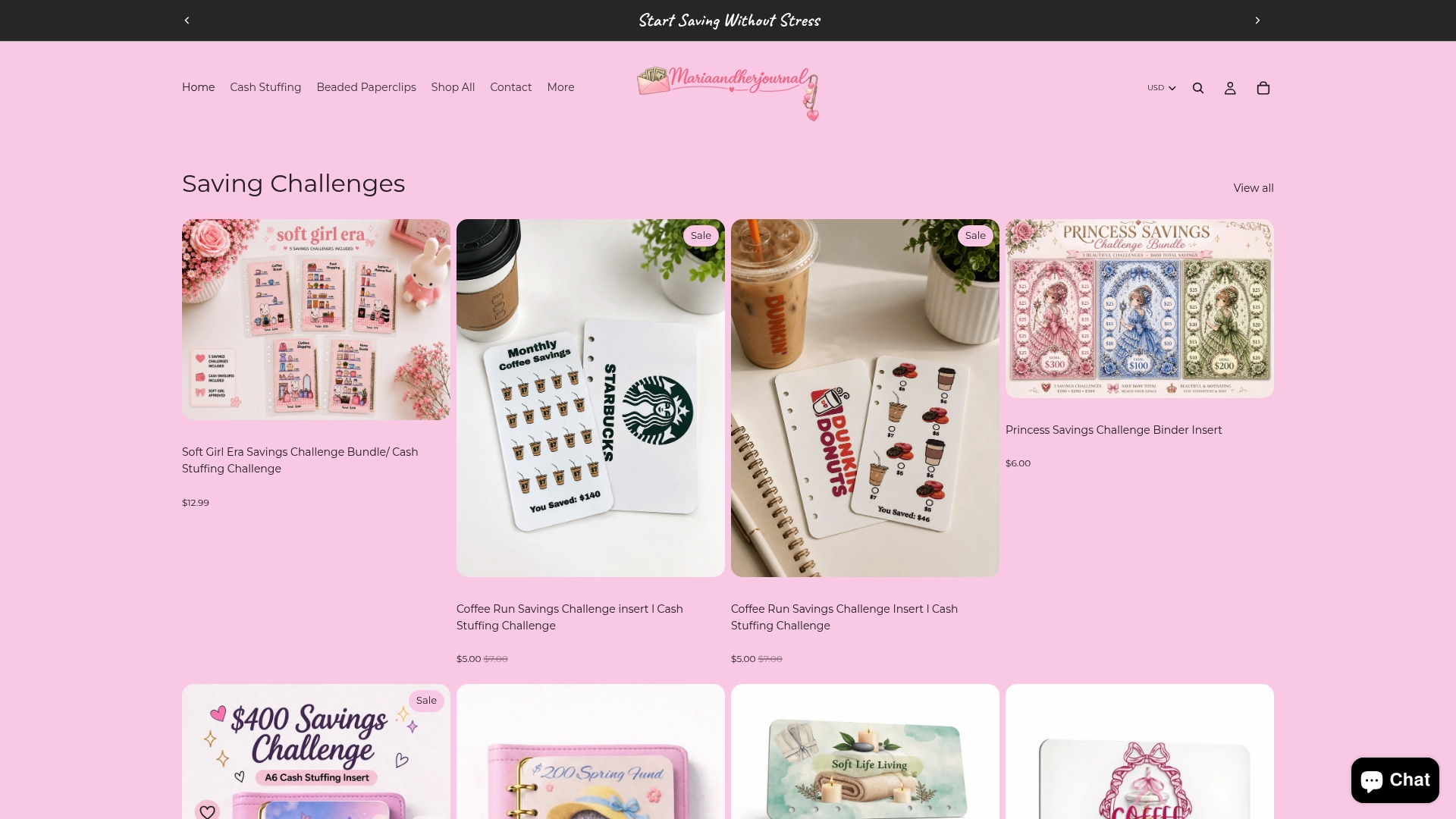
Every bundle is an instant digital download, sized for US Letter, A4, and A6 binder pockets, and designed to look good on a fridge or inside a budget binder. Pick your goal, download the bundle, and color your first segment today. Browse the full savings challenge collection and find the tracker that fits your goal.
Sources
This article is general information, not a substitute for advice from a qualified financial advisor. Consult a qualified financial professional about your own circumstances before acting on anything here.