

A dice savings challenge is a game-based saving method where you roll one or more dice, multiply the result by a set base amount, and deposit that dollar figure into savings. Roll a six on a $10 base, and you save $60 that round. It’s random, it’s fast, and it works surprisingly well as a habit builder. Fidelity includes it among practical savings challenges worth trying. This guide covers the exact rules, popular variants, realistic savings math, and where to find printable trackers or handmade bundles to make it stick.
Key Takeaways
The dice savings challenge is one of the most sustainable fun saving methods available because the randomness keeps each deposit feeling like a choice, not a chore.
| Point | Details |
|---|---|
| Start with a small base amount | Set your base at 1–2% of monthly take-home pay so even a max roll stays affordable. |
| Expected savings are real | A $15 weekly base with one die produces roughly $2,730 over — weeks. |
| Use a physical tracker | Laminated boards and cash-stuffing envelopes improve follow-through compared to digital-only logging. |
| Keep savings FDIC-insured | Store dice-challenge funds in an FDIC-insured account so deposits are protected up to applicable limits. |
| Mariaandherjournal bundles | Ready-made kits with laminated trackers, envelopes, and accessories are available at Mariaandherjournal. |
Table of Contents
- How does the dice savings challenge work, step by step?
- What are the most popular dice challenge variants?
- How much will you actually save? Real math for common timeframes
- Where can you find trackers, printables, and apps?
- How do you keep the dice savings challenge going long-term?
- Why handcrafted trackers make the dice challenge more effective
- Why the dice challenge is worth taking seriously
- Ready-made dice challenge bundles from Mariaandherjournal
- Sources
How does the dice savings challenge work, step by step?
The setup takes about five minutes. Here’s what you need and how to run it.
What you need:
- One standard six-sided die (or a dice app)
- A base dollar amount you’ve chosen in advance
- A dedicated savings envelope or bank account
- A tracker (printed sheet, laminated board, or app)
Steps to play the monthly version:
- Pick your base amount. Start small — $5 to $25 works for most budgets.
- On your chosen roll day (same day each week or month), roll the die.
- Multiply the result by your base amount. Roll a 4 on a $15 base: save $60.
- Transfer that amount to your savings account or stuff it into your envelope.
- Mark the roll on your tracker and note the running total.
- Repeat on schedule.
Rules for missed rolls: Life happens. If you skip a roll day, roll the next day and deposit as normal. Don’t double up unless you want to — skipping one round rarely derails the whole challenge. What matters is getting back on schedule, not punishing yourself for a miss.
That way, even a maximum roll stays within a range you can cover without stress. A $3,000 monthly income suggests a $30–$60 base, meaning your worst-case roll is $180–$360 for the month — uncomfortable but not catastrophic.*
For more on building a repeatable saving habit around short challenges, the weekly savings challenge guide at Mariaandherjournal walks through the habit-formation side in detail.
What are the most popular dice challenge variants?
The basic one-die version is just the starting point. Most people eventually tweak the rules to match their budget or motivation style.
One die vs. two dice vs. three dice
With a single six-sided die, your rolls land between 1 and 6, averaging 3.5. Two dice average 7, and three dice average 10.5. More dice means higher average deposits and a wider spread of outcomes — which adds excitement but also raises the ceiling on any single roll. A two-dice version on a $25 base could ask you to save anywhere from $50 to $150 in one round.
Weekly micro-rolls
Instead of one big monthly roll, you roll every week. The individual deposits are smaller, but the frequency builds the habit faster. This version suits people who prefer steady, visible progress over occasional larger transfers.
The collection board variant
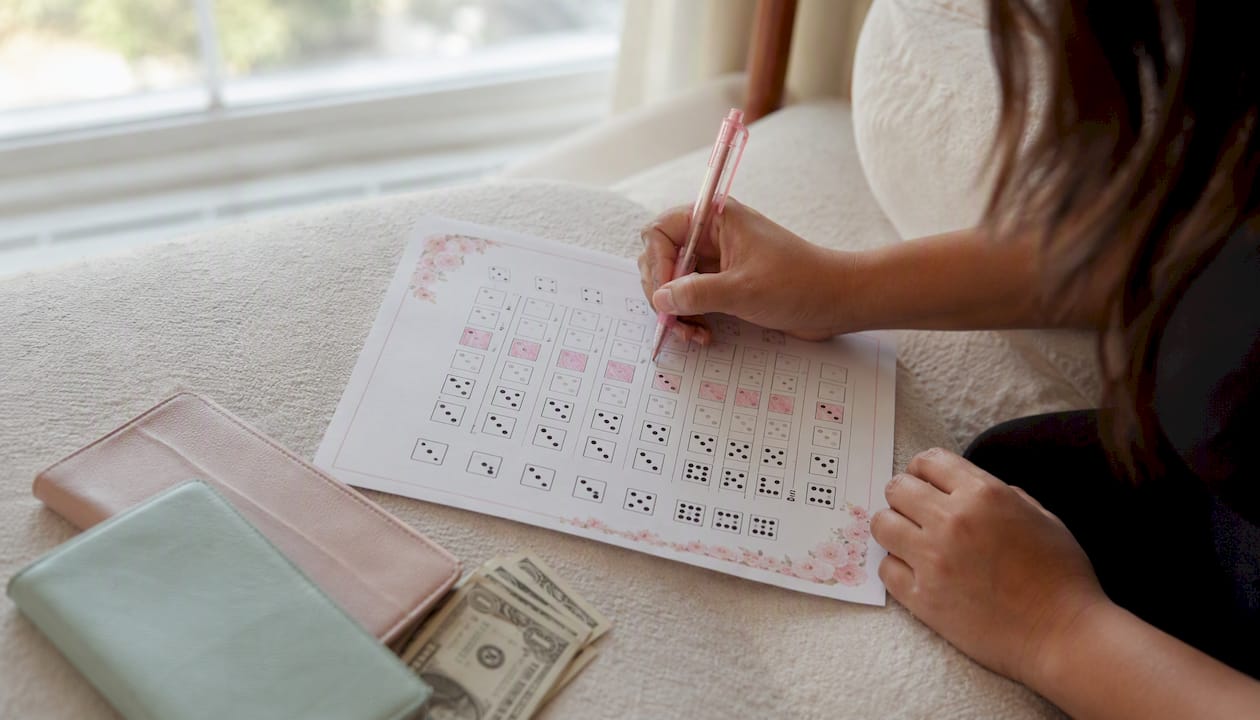
Each face value on the die maps to a square on a printed board. When you roll a 3, you color in a “3” square and deposit the corresponding amount. Once all squares are filled, the challenge is complete. One popular commercial version of this format targets a completion goal around $441, as seen with Turtle Savings’ Dice Collection Savings Challenge. The visual progress is the whole point — it’s closer to a scratch-off savings challenge in feel.
Scratch-off tracker variant
Physical scratch-off trackers work the same way but add a tactile reward: you scratch off the square after depositing. Products like the Dice Decider format use this mechanic with laminated cards and flexible saving options. The scratch-off format tends to keep engagement higher over longer timeframes because each roll feels like a small win.
Special rules worth knowing
- Roll-down rule: If a roll produces an amount you genuinely can’t cover that round, roll again and take the lower result. Use sparingly.
- Minimum floor: Set a floor (say, always save at least $10) so low rolls still move the needle.
- Split large rolls: On a two-dice version, a maximum roll can be split across two months if needed.
- Bonus month: Some players add a thirteenth roll in December as a year-end boost.
If the dice format feels too unpredictable, the beginner savings challenge ideas at Mariaandherjournal list structured alternatives with fixed weekly amounts.
How much will you actually save? Real math for common timeframes
The formula is straightforward: average roll × base amount × number of rolls = expected total.
Average roll values: one die = 3.5, two dice = 7.0, three dice = 10.5.
These are averages, so actual results vary. Over enough rolls, the law of large numbers pulls your total close to the expected figure.
SavingsRoom’s worked examples estimate annual savings in the a moderate range using a $25 base with two dice and monthly rolls — a realistic middle-ground target for most households.
What do those numbers mean practically? A modest annual total from a $25 monthly base covers a solid starter emergency fund. The a figure close to one month’s income buffer from a weekly $15 roll gets close to a one-month income buffer for many earners. The daily versions produce larger totals but require more discipline to sustain.
Because results are random, adding a floor rule (minimum deposit regardless of roll) smooths out the low-roll months and keeps your total closer to the expected figure.
Where can you find trackers, printables, and apps?
The tracker is what turns a dice roll into a visible savings habit. Without one, it’s easy to lose track of your running total and lose motivation around week six.
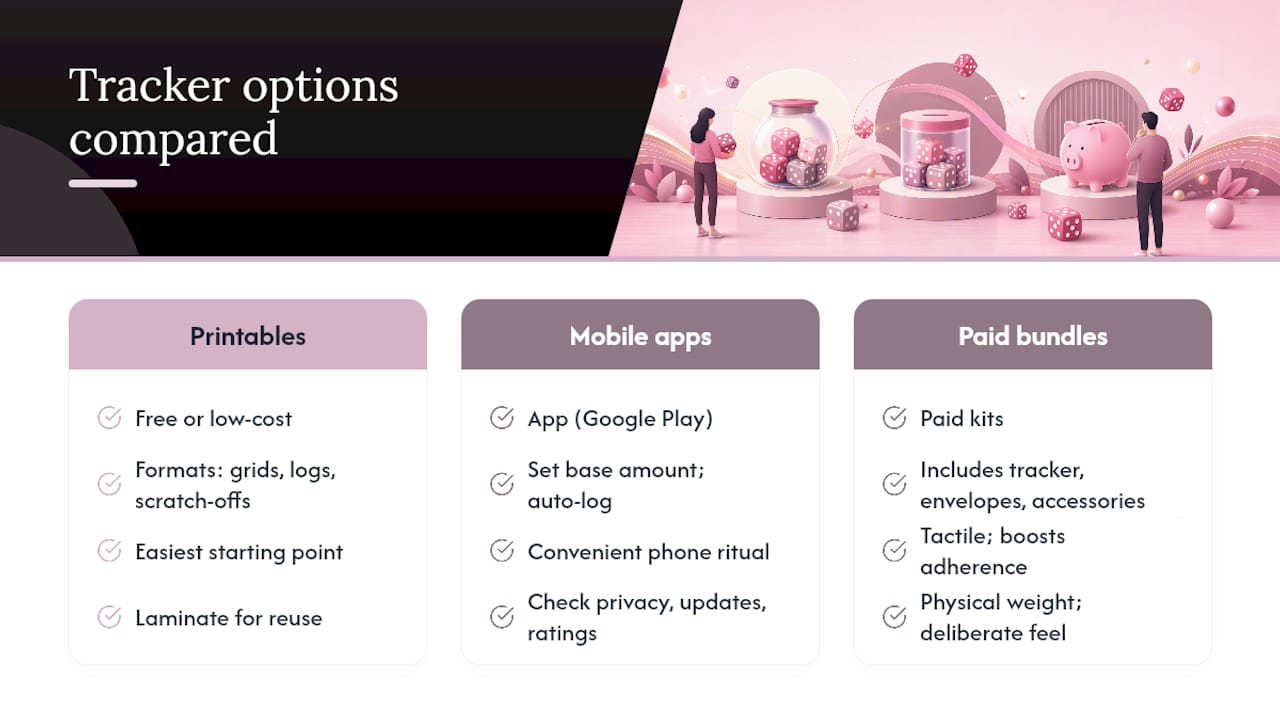
Free printables are the easiest starting point. Pinterest has dozens of dice challenge boards in various formats — collection-style grids, simple log sheets, and scratch-off-style layouts.
Mobile apps bring the whole ritual to your phone. The Savings Challenge Dice app on Google Play lets you set a base amount, roll virtually, and log each result automatically. Before installing any money-related app, check its data-safety section in the Google Play store and review the developer’s privacy policy before entering any account information. Stick to apps with recent updates, a meaningful number of ratings, and no mandatory account creation for basic logging.
Handmade and paid bundles sit at the other end of the spectrum. Mariaandherjournal’s savings challenge bundles combine laminated trackers, cash-stuffing envelopes, and decorative accessories into a single kit designed specifically for the roll-and-save ritual. The physical weight of a laminated board and a dedicated envelope makes the habit feel more deliberate than a phone tap — and that tactile difference shows up in how long people stick with it.
Pro Tip: Laminate your tracker even if it’s a free printable. A dry-erase marker lets you reset the board for a second round without reprinting, and the durability keeps it looking good on your desk for months.
The savings challenges printable guide at Mariaandherjournal covers print specs and how to pair different tracker formats with specific challenge types.
How do you keep the dice savings challenge going long-term?
Starting is easy. Month four is where most people quietly stop. These habits prevent that.
- Automate the transfer. After each roll, set up a one-time bank transfer immediately rather than relying on memory. Many banks let you schedule same-day transfers from a mobile app in under a minute.
- Set a calendar reminder. Pick the same day and time each week or month for your roll. Treat it like a bill due date.
- Use a sub-account. Keep dice-challenge savings in a separate account from your checking. Out of sight, harder to spend. Make sure that account is FDIC-insured so your deposits are protected up to applicable limits.
- Handle large rolls with a plan. Decide in advance what you’ll do if a two-dice roll lands at 12 on a $50 base ($600). Split it across two months or invoke the roll-down rule — just decide before it happens, not in the moment.
- Roll with a partner. A spouse, roommate, or friend doing the same challenge creates natural accountability. Compare totals monthly.
- Post your tracker somewhere visible. A laminated board on the fridge or a planner page you open daily keeps the challenge in your peripheral vision.
If you eventually hit your savings goal and want to put that money to work, keep the brokerage side of things clean: SIPC explains protections for brokerage accounts, and FINRA BrokerCheck lets you verify any firm before opening an account.
For broader advice on making any savings challenge last, the challenge saving money tips at Mariaandherjournal go deeper on the psychology of sticking with it.
Why handcrafted trackers make the dice challenge more effective
There’s a real difference between tracking a roll on a phone and marking it on a physical board you made space for on your desk. The physical act of writing a number, coloring a square, or scratching off a cell creates a moment of completion that a digital log entry doesn’t quite replicate.
Mariaandherjournal makes handmade budgeting stationery built around exactly this idea. The product line includes:
- Savings challenge bundles with laminated tracker boards sized for the dice challenge format
- Cash-stuffing envelopes for physically separating each roll’s deposit from everyday spending money
- Beaded paperclip bookmarks that mark your current page in a budget binder and add a small aesthetic reward to the tracking ritual
- Budget binders and planner accessories that keep all your savings challenge materials in one place
The combination matters. A laminated tracker you can wipe and reset, paired with labeled envelopes for each month’s deposit, turns the dice challenge from a loose game into a structured system. Customers who use physical trackers alongside cash-stuffing envelopes tend to report clearer visibility into their progress and fewer “where did that money go?” moments.
Handmade trackers work because they create a ritual, not just a record. When the act of marking your roll feels intentional, you’re more likely to show up for the next one.
Pro Tip: Use one cash-stuffing envelope per month labeled with the month and your target range. When the envelope is full, transfer the cash to your savings account. The envelope acts as a physical checkpoint that makes it obvious when you’ve hit your goal.
Why the dice challenge is worth taking seriously
The dice savings challenge gets dismissed sometimes as a gimmick. I’d push back on that. The randomness is the feature, not the flaw. Fixed savings plans fail because they’re boring — the same amount, the same day, forever. A dice roll introduces just enough unpredictability to make each deposit feel like an event rather than a chore.
What I’ve seen, working with budgeting tools and trackers, is that the people who stick with savings challenges longest are the ones who’ve made the process feel like something they do rather than something that happens to their bank account automatically. The dice challenge, especially paired with a physical tracker and cash-stuffing envelopes, puts the saver back in the driver’s seat in a way that pure automation doesn’t.
The math is also honest. A $15 weekly base with one die produces a notable amount over a year — not life-changing, but a real emergency fund or a vacation paid in cash. That’s a goal you can see and feel, not just a number in an app.
Ready-made dice challenge bundles from Mariaandherjournal
Readers who want to skip the DIY setup and start rolling immediately have a ready option. Mariaandherjournal’s savings challenge bundles include laminated tracker boards, cash-stuffing envelopes, and decorative accessories — everything in one handmade kit.

Each bundle is designed to fit the roll-and-save ritual without requiring any extra supplies. The cash-stuffing essentials collection pairs directly with the dice challenge for anyone who prefers a physical envelope system over a bank transfer.
Key details worth knowing:
- Laminated trackers are reusable across multiple challenge rounds
- Envelopes are sized for cash stuffing and labeled for monthly organization
- Beaded paperclip bookmarks and planner accessories are included in select bundles for the full ritual experience
Browse the savings challenge collection and pick the bundle that matches your base amount and timeframe.
Sources
- Fdic
- Sipc
- Brokercheck
- 10 money savings challenges for 2026
- Savings Dice Game: The Roll That Grows Your Stash | SavingsRoom