

Pick your full target, choose a timeline, and set up an automatic transfer to a high-yield savings account today. That single move, done before you read another paragraph, is the difference between a house savings challenge that stalls in March and one that actually funds a closing.
Your target isn’t just the down payment. It’s down payment plus closing costs plus reserves plus moving expenses, all added together and divided by the number of months you’re giving yourself. If you want a template to start with right now, pick one:
- Fixed monthly amount: Total target ÷ months = your automated transfer, no adjustments needed.
- Paycheck percentage: Send 10 to 20% of every paycheck straight to your house fund before you see it.
If you’re earning well and want to move fast, aim for a 1 to 2 year aggressive timeline. If your income is steadier but tighter, a 3 to 5 year plan removes the pressure without removing the progress.
Key Takeaways
A house savings challenge succeeds when a fixed monthly number, an automated transfer, and a visible tracker all work together instead of relying on willpower alone.
| Point | Details |
|---|---|
| Calculate your full target | Add down payment, closing costs, reserves, and moving costs, then divide by your timeline in months. |
| Choose a template that fits your income | Fixed monthly amounts suit stable pay; paycheck percentages and escalating ladders suit variable income. |
| Keep funds in cash equivalents | Use a high-yield savings account or money market account for any purchase timeline under 5 years. |
| Automate and track together | Pair automatic transfers with a physical tracker to convert invisible progress into visible motivation. |
| Use a handmade tracker to stay visible | Mariaandherjournal’s Saving Challenges bundles pair printable schedules with tactile trackers for exactly this purpose. |
Table of Contents
- Why a House Savings Challenge Actually Works
- Which Savings Challenge Template Should You Pick?
- What Should Your Total Target Include?
- Where Should You Keep House Savings Money?
- How Do You Stay Consistent Without Losing Momentum?
- How Maria and Her Journal Fits Into a House Savings Challenge
- How Do You Stay Mentally Committed to a Multi-Year Goal?
- What Common Obstacles Derail a House Savings Challenge?
- Can You Adjust the Challenge When Income or Expenses Change?
- How Do Side Income and Bonuses Speed Up Your Timeline?
- What Actually Matters More Than the Perfect Plan
- Ready to Start Your Savings Challenge?
- Frequently Asked Questions
- Sources
Why a House Savings Challenge Actually Works
The math is what makes a challenge different from just “trying to save more.” Once you divide your total target by your timeline, you get one fixed number, and that number removes every excuse. There’s no wondering how much to move this month. You already know.
Behavioral finance backs this up. Commitment devices, the small promises you make to your future self, work because they turn a vague goal into a concrete action. Visible progress, like a printable tracker you color in every week, builds momentum in a way a bank app balance never quite manages.
Before you lock in a number, run it against the Experian 36/43 affordability rule: your total housing costs should stay under 36% of gross monthly income, and total debt under 43%. It’s a guardrail, not a hard cap, but it keeps your savings goal tied to a mortgage payment you can actually afford later.
- Divide total target by months, not by guesswork.
- Check your future payment against the 36/43 rule before finalizing your number.
- Use a visible tracker to convert the abstract goal into daily motion.
Which Savings Challenge Template Should You Pick?
Templates work because they remove decision fatigue. Instead of asking “how much should I save this week,” you follow a schedule someone already built. Here are four that cover most budgets and most timelines.
- The 52-week challenge. Save a different amount each week, starting small ($5 to $10) and increasing gradually. Works well for building the habit before scaling up.
- Fixed monthly contribution. Best for people who want predictability. A $30,000 target over 24 months means $1,250 a month; over 36 months, $833; over 60 months, $500.
- Escalating ladder. Start at $50 a month and add $25 every quarter. Gentle on tight budgets, but still builds real momentum by month twelve.
- Paycheck percentage. Automatically route 10 to 15% of every paycheck. Scales naturally with raises, bonuses, and side income.
For a $10,000 goal, the math is friendlier: a fixed monthly amount over your timeline that matches your income. If those numbers feel out of reach right now, low-income-friendly variations swap fixed dollar amounts for percentage-based or round-up methods that flex with irregular income.
- Pick the template that matches your income stability, not just your target size.
- Print it, post it, and physically mark off progress.
What Should Your Total Target Include?
Most first-time buyers underestimate their number because they only budget for the down payment; following first home interior design budget tips for Singapore can help manage overall spending effectively. Redfin and other housing guides recommend saving for the full cost stack: down payment (3 to 20% depending on loan program), closing costs (2 to 5% of the purchase price), 3 to 6 months of PITI reserves, and $2,000 to $5,000 for moving and one-time setup costs.
That’s a $50,000 target. Stretch it over 36 months and you’re saving $1,389 a month. Over 60 months, that drops to $833.
If the number still feels too big, you have three real levers: accept a lower down payment through an FHA, VA, or USDA loan, extend your timeline, or shop a lower price point. Down payment assistance programs through state housing finance agencies can also shrink the out-of-pocket number significantly.
- Down payment: 3 to 20% of purchase price.
- Closing costs: 2 to 5%.
- Reserves: 3 to 6 months of PITI.
- Moving and setup: $2,000 to $5,000.
Pro Tip: *Run your total target through an FHA calculator before committing to a five-year timeline.
Where Should You Keep House Savings Money?
For a timeline of five years or less, Fidelity recommends keeping your house fund in cash equivalents, not stocks. A high-yield savings account (HYSA) or money market account is the standard choice, and short-term CDs work if you know your exact purchase date and won’t need early access.
The yield gap is real money. A HYSA paying around 4.5% on $50,000 earns meaningfully more than the same balance sitting in a checking account paying near 0.1%. Over a two or three year challenge, that difference can cover a chunk of your closing costs on its own.
Avoid the temptation to chase higher returns in stocks or crypto if you’re buying within five years. Sequence-of-returns risk means a market downturn right before closing could gut your down payment exactly when you need it most.
- Use a HYSA or money market account for timelines under 5 years.
- Consider short-term CDs only if your purchase date is fixed and known.
- Skip equities and crypto entirely for house funds you’ll need within 5 years.
How Do You Stay Consistent Without Losing Momentum?
Automation removes willpower from the equation. Set up a payroll deposit split, a recurring bank transfer the day after payday, or a round-up feature that sweeps spare change into your house fund automatically.
Tracking is the other half. Printable trackers, cash-stuffing envelopes, spreadsheets, and habit apps all work, but the ones that actually get finished tend to be visible ones taped to a wall or kept in a binder you open weekly. A printable savings tracker turns an invisible bank balance into something you can physically color in, which matters more than it sounds like it should.
Build in a check-in habit: a five-minute weekly review of what moved, and a monthly conversation if you’re saving with a partner. Set a rule ahead of time for missed months, like doubling up the following month or pulling from a small contingency buffer, so one bad week doesn’t turn into a abandoned challenge.
- Automate transfers the day after each paycheck lands.
- Pair a physical tracker with your bank’s automatic transfer.
- Set a contingency rule for missed months before you need it.
Pro Tip: Do your weekly check-in on the same day you pay bills. Piggybacking the habit onto something you already do weekly makes it stick.
How Maria and Her Journal Fits Into a House Savings Challenge
Maria built Mariaandherjournal around a simple observation: budgeting sticks better when you can see it and touch it, not just glance at an app balance. That’s the thinking behind the brand’s cash stuffing envelopes and savings challenge bundles, made by hand rather than mass produced.
Customers regularly report that pairing a printable tracker with their bank’s automation made their house fund feel real for the first time. One common pattern: a buyer running a 36-month challenge uses a printable bundle to mark off each deposit, hits the halfway point, and finds the visible progress motivates them to add extra deposits from tax refunds or bonuses, shaving months off the original timeline.
Visual trackers and simple automation together produce better follow-through than automation alone. Seeing the progress is what keeps people going after the initial motivation fades.
- Use the tracker to mark deposits the same day your automated transfer clears.
- Combine a printed challenge bundle with any template from this guide.
- Let the physical marking do the motivational work automation can’t.
How Do You Stay Mentally Committed to a Multi-Year Goal?
The hardest part of a house savings challenge isn’t the math. It’s staying interested in a goal that’s eighteen months away when a friend’s vacation photos show up on your phone every day.

One shift that helps: treat your monthly transfer like a bill, not leftover cash. If rent or a car payment is non-negotiable, your house fund transfer should carry the same weight. Households that reframe savings this way tend to finish faster than ones that save “whatever’s left” after spending, because there’s rarely much left.
Break the timeline into smaller wins. A 36-month goal is exhausting to think about in full. A quarterly milestone, hitting $5,000 or $10,000, gives you something to actually celebrate along the way. Mark it on your tracker, tell someone, treat yourself to something small and free like a nice dinner at home.
Watch for comparison fatigue. Scrolling through other people’s home purchases or renovation posts while you’re still in month eight of your challenge can make your own pace feel slow even when it isn’t. Limit that input if it’s draining your motivation instead of feeding it.
Finally, keep the why visible. Whether it’s a photo of a neighborhood you love or a note about the yard you want, put a visual reminder next to your tracker. The math gets you there, but the reason you started is what gets you through the months where progress feels invisible.
What Common Obstacles Derail a House Savings Challenge?
Income volatility is the most common one. Freelancers, hourly workers, and commission-based earners often set a fixed monthly target that works in a good month and fails in a slow one, then feel like they’ve broken the whole challenge.
The fix isn’t willpower, it’s rebuilding the plan around a range instead of a fixed number. Set a minimum you can hit even in a bad month, and treat anything above that as a bonus deposit.
Unexpected expenses are the second big derailer. A car repair or medical bill eats into the house fund, and the temptation is to feel like the challenge failed. It didn’t. Build a small buffer into your budget specifically for these events so your house fund stays untouched when life happens.
Lifestyle creep is quieter but just as damaging. A raise or bonus often gets absorbed into slightly nicer everyday spending instead of the house fund. Redirecting even half of any raise straight into your automated transfer keeps your timeline on track without requiring a lifestyle sacrifice.
Lastly, watch for challenge fatigue around month six or seven, right when the initial motivation wears off but the finish line still feels far away. This is exactly where a visible tracker earns its keep: it gives you proof of progress on the days your bank balance alone doesn’t feel convincing.
- Rebuild your monthly target around a realistic minimum, not a best-case number.
- Keep a small separate buffer for emergencies so they don’t raid your house fund.
- Redirect part of every raise or bonus straight into automated transfers.
Can You Adjust the Challenge When Income or Expenses Change?
Yes, and you should expect to. A house savings challenge built on a rigid number that never flexes is one that eventually gets abandoned the first time life doesn’t cooperate.
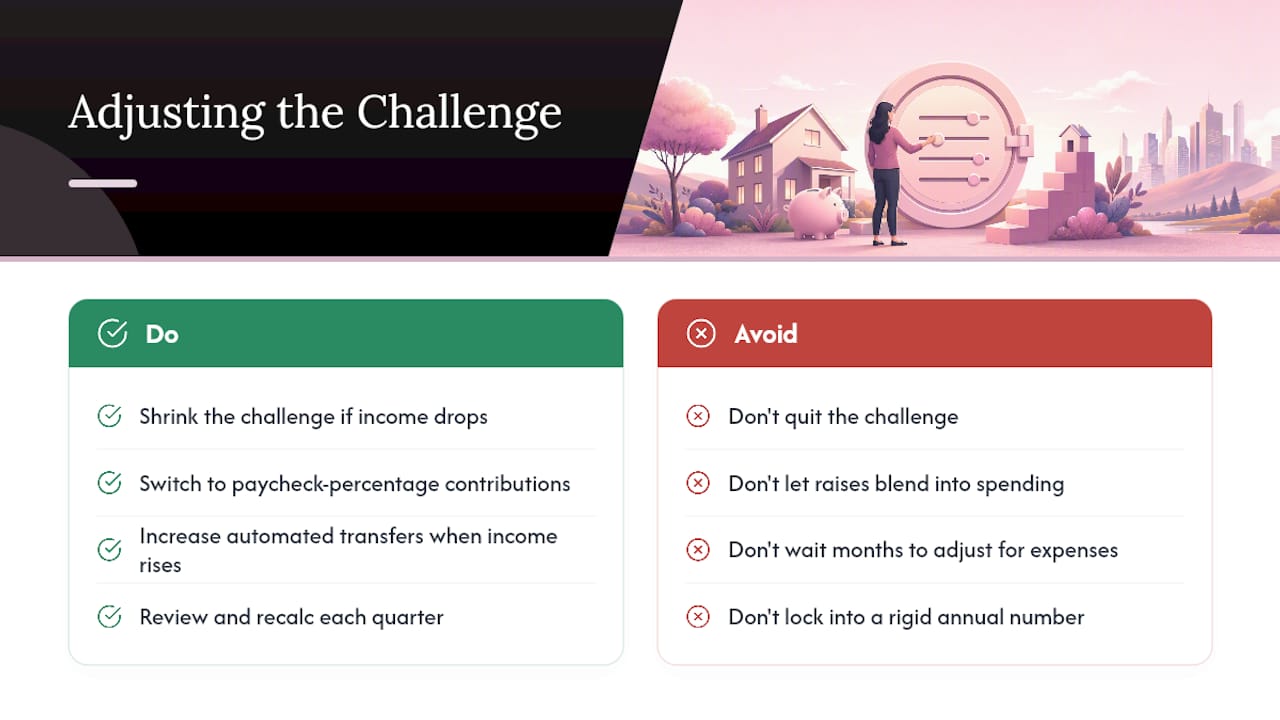
If your income drops, don’t quit the challenge, shrink it. Recalculate using your total target divided by a longer timeline, or temporarily switch from a fixed monthly amount to a paycheck percentage, which naturally scales down with lower pay instead of creating a shortfall you have to explain to yourself.
If your income rises, whether from a raise, a new job, or a side gig, resist the urge to just let the extra money blend into your regular spending. Recalculate your target divided by a shorter timeline and increase your automated transfer to match. This is often the fastest way to shave a full year off a challenge without feeling a lifestyle hit.
Expenses that shift matter too. If rent goes up or a subscription creeps in, revisit your monthly target the same week, not three months later when you’ve built a habit around a number that no longer fits your actual budget. Templates like the escalating ladder or paycheck-percent method are built for exactly this kind of flexibility, since they respond to your actual cash flow instead of locking you into a number set a year ago.
Review your challenge every quarter regardless of whether anything obvious changed. A quick check keeps small drifts, a slightly higher grocery bill, a new expense, from quietly derailing a plan you built carefully months earlier.
How Do Side Income and Bonuses Speed Up Your Timeline?
Extra income is often the fastest lever in the entire challenge, faster than cutting expenses in most cases. Chase’s guidance on saving for a first home points out that increasing income tends to move the needle more than trimming small recurring costs, largely because there’s a limit to how much you can cut but no real ceiling on how much you can earn.
Treat every dollar of side income as house fund money by default, not spending money that has to be redirected after the fact. Set up a rule ahead of time: freelance income, overtime pay, tax refunds, and cash gifts go straight into the automated transfer, no decision required in the moment.
Tax refunds deserve special attention because they arrive as a lump sum. A $2,500 refund dropped into a 36-month, $50,000 challenge effectively cuts about a month and a half off your timeline in one deposit. Bonuses work the same way; if you get an annual bonus, decide in advance what percentage goes to the house fund before the money hits your account and starts feeling like it’s yours to spend elsewhere.
If you’re taking on a side gig specifically to fund your house purchase, treat that income as separate from your regular paycheck-percentage transfer. Route it through its own line item on your tracker so you can see, in a very literal way, how much of your progress came from the extra hustle versus your baseline savings rate.
What Actually Matters More Than the Perfect Plan
Most advice on house savings challenges spends too much time optimizing the spreadsheet and not enough time on what actually determines whether someone finishes: whether the plan survives contact with a bad month.
The math in this guide, divide your total by your timeline, matters. But I’d argue the real leverage point is visibility, not precision. A household with a slightly imperfect monthly number and a tracker they check every week will almost always outpace a household with a perfectly calculated number and no visual accountability. The number gets abandoned quietly; the tracker gets noticed.
Where I think conventional advice falls short is in treating every challenge like it should run on autopilot from day one. Automation is necessary, but it’s not sufficient on its own, because automation is invisible by design. You stop noticing a transfer after the third month. A physical tracker forces you to notice, which is exactly the friction that keeps a multi-year goal from quietly dying.
If you take one thing from this guide, prioritize the visible system before you obsess over the perfect template. Pick a target, automate it, and give yourself something tangible to mark up every week.
Ready to Start Your Savings Challenge?
You’ve got the math, the templates, and the account strategy. What most people are missing isn’t information, it’s a system that keeps them looking at their progress instead of forgetting about it between paydays.

That’s exactly what our Saving Challenges collection is built for. Each bundle pairs a printable schedule, whether that’s a 52-week ladder or a fixed-monthly grid, with a tracker you fill in by hand, so your automated transfer has a visible partner instead of disappearing into a bank app. Add a beaded paper clip to mark your current week, and the whole system becomes something you actually want to open, not just maintain.
Start with a starter bundle sized to your target, whether that’s $10,000, $30,000, or a full down payment fund. Browse the Saving Challenges collection and pick the template that matches the timeline you set earlier in this guide.
Frequently Asked Questions
How much should I save each month for a house savings challenge? Divide your full target, down payment plus closing costs plus reserves plus moving expenses, by the number of months in your timeline. A $50,000 target over 36 months comes out to about $1,389 a month.
What’s the best house savings challenge template for beginners? The fixed monthly contribution template is easiest to start because it removes weekly decision making. The 52-week challenge works well if you want to build the habit gradually before committing to a larger fixed number.
Where should I keep money for a house down payment? A high-yield savings account or money market account is the standard recommendation for any purchase timeline under five years. Avoid stocks or crypto for this money because a market downturn right before closing could shrink your down payment when you need it most.
How do I stay motivated during a multi-year savings challenge? Break the goal into quarterly milestones instead of thinking about the full total, and use a visible tracker you can physically mark up. Treating your monthly transfer like a fixed bill rather than leftover cash also keeps momentum steady.
Can I adjust my house savings challenge if my income changes? Yes. If income drops, recalculate using a longer timeline or switch to a paycheck-percentage method. If income rises, shorten your timeline and increase your automated transfer to finish faster.
Sources
- How to save for a house | Experian
- How to Save for a House in 9 Steps | Redfin
- How to save money to buy a house | Opendoor
- How to save for a house | Fidelity